

How to Read a Moving Estimate: Weight, Cubic Feet, Fees
Read an interstate moving estimate line by line: binding or not, weight vs cubic feet, the density trick, extra fees and the most you pay at delivery.
Published October 27, 2026 · 9 min read · By My Fast Movers
In short
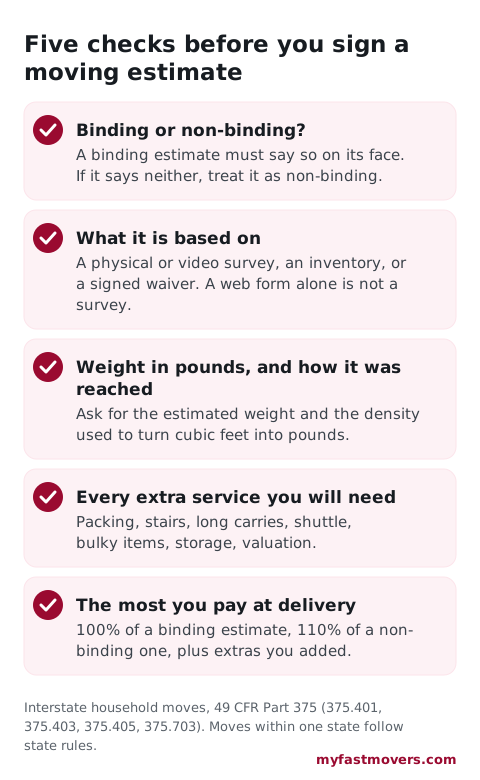
Check five things: whether the estimate says binding or non-binding on its face, what it is based on (a physical or video survey, or nothing), the weight or volume and how one became the other, every extra service listed, and the maximum you must pay at delivery: 100 percent of a binding estimate or 110 percent of a non-binding one.
Read an interstate moving estimate for five things: whether it says binding or non-binding on its face, what it is based on, the weight and how it was reached, every extra service on it, and the maximum you can be made to pay at delivery. Most bad surprises on moving day were already visible in the estimate. They just were not read.
This guide walks through an estimate the way you would read it at the kitchen table, with the federal rules that apply to interstate household moves (49 CFR Part 375). Moves inside one state follow that state’s rules, which are often similar but not the same.
1. Binding or non-binding: find the word
Every interstate estimate is one or the other, and the difference decides how much the final bill can move.
- Binding. The price is fixed for the goods and services listed. Federal rules require a binding estimate to “clearly indicate upon each binding estimate’s face that the estimate is binding upon you and the individual shipper” (375.403). If you add goods, the mover must reaffirm it, write a new binding estimate, or convert it to non-binding in writing before loading.
- Non-binding. It is the mover’s “reasonably accurate estimate of the approximate costs” (375.405). The final bill follows the actual weight and services, so it can come in higher or lower.
If the document does not say which it is, treat it as non-binding and ask for the answer in writing.
A non-binding estimate must be free and in writing. A mover may charge for a written binding estimate (375.401), so ask about the fee before the survey.
2. What the number is based on
An interstate mover must do a physical survey before writing your estimate (375.401). A survey can be done “on-site or virtually”, and a virtual one means live or pre-recorded video of your home (375.103). You can waive the survey, but only in writing and signed before your goods are loaded. If your mover offers a video survey, how to get a virtual moving estimate that holds covers what to show on the call.
So look for one of these on the estimate or in the email that came with it:
- the date of an in-home or video survey, or
- an inventory you walked through with the mover, or
- a written waiver you signed.
If none exists, the number came from a web form or a phone call. That is where loading-day revisions start, because nobody has yet looked at what you own.
3. Weight, volume and the density trick
Long-distance moves are usually billed on the scale weight of your shipment under the mover’s tariff. Local moves are usually billed by the hour; see local movers cost per hour for that case.
Many estimates start from volume because it is easier to judge from a walk-through: so many cubic feet of furniture and boxes. To price a weight-based move, the volume has to become pounds, and that needs a density: pounds per cubic foot. The density is where two estimates for the same home can quietly part ways.
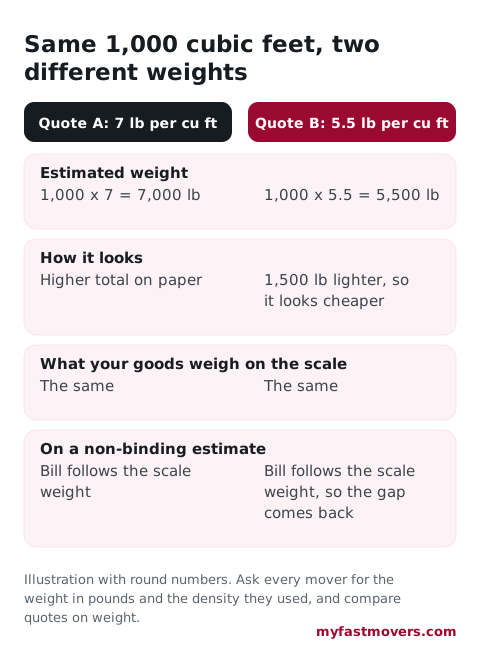
Take two quotes for the same 1,000 cubic feet:
| Quote A | Quote B | |
|---|---|---|
| Volume | 1,000 cu ft | 1,000 cu ft |
| Density used | 7 lb per cu ft | 5.5 lb per cu ft |
| Estimated weight | 7,000 lb | 5,500 lb |
Quote B prices 1,500 fewer pounds, so it looks cheaper. Your furniture weighs the same either way. If the move is non-binding, the bill follows the scale, and the “cheap” quote catches up at weigh-in. That is the arithmetic behind most “the price doubled” stories.
What to do with that:
- Ask each mover for the estimated weight in pounds, not only cubic feet, and for the density they used.
- Compare quotes on weight, not on the total. A quote with a much lower weight for the same inventory is not cheaper; it is optimistic. How to compare moving quotes shows how to put several quotes on the same weight and negotiate from there.
- Know your weighing rights. You may watch every weighing (375.513). Before unloading starts you can demand a reweigh, and the bill must be based on the reweigh weight (375.517). The federal booklet says the mover may not charge you for the reweigh, and that the charges follow the reweigh weight even if it comes out higher.
4. The line items
Transportation is one line. Everything else is an extra service, and each one should be on the estimate if you will need it:
- Packing and materials: per carton or per hour. See packing services cost.
- Access fees: stairs, elevators, long carries from the truck to your door, and a shuttle truck if a full trailer cannot reach your street.
- Bulky items: pianos, hot tubs, gym equipment and similar.
- Storage in transit if your new home is not ready. See storage in transit vs self storage.
- Valuation: the protection level you chose. See moving insurance and valuation explained.
The rule of thumb is simple: if you know you have stairs, a piano or a narrow street, and it is not on the estimate, it will be on the bill. Hidden moving costs and extra fees lists them in detail.
5. The most you can be made to pay at delivery
This is the most important number on the paperwork, and it is required on the bill of lading. What to check on the bill of lading before you sign covers that document and the 3-day rule for signing it.
- Binding estimate: the maximum at delivery is the exact estimate (375.703), plus charges for services you asked for after the bill of lading was issued and certain impracticable-operation charges.
- Non-binding estimate: the maximum at delivery is 110 percent of the estimate (375.703), plus the same extras. Once you pay that, the mover must hand over your goods. The rest is billed later; the federal booklet says remaining charges are billed after 30 days from delivery.
So on a non-binding estimate of $4,000 for transportation, the most you can be required to pay at the door for those services is $4,400. If a crew demands more before unloading, see what to do when movers hold your belongings.
Red flags in the paperwork
- No “binding” or “non-binding” anywhere.
- Volume only, with no weight and no density.
- No survey date, no inventory and no waiver.
- A large deposit before any survey.
- A company name that is not the one you called. That usually means a broker; see moving broker vs carrier and how to check a mover’s USDOT number.
Use a model number as a sanity check
Before you read any quote, get a neutral figure for your move from the moving cost calculator. It needs no phone number or email and shows how the number is built. It is a model estimate, not a quote. Its value is that a written estimate far below it is the one that needs the hardest reading.
Questions people ask
What is the difference between a binding and a non-binding moving estimate?
A binding estimate fixes the price for the goods and services it lists, and federal rules require it to say on its face that it binds both you and the mover. A non-binding estimate is the mover's reasonably accurate estimate of the approximate cost; the final bill follows the actual weight and services. On a non-binding estimate the most the mover can demand at delivery is 110 percent of the estimate, with the rest billed later.
Why do movers quote in cubic feet?
Volume is easy to estimate from a walk-through or a list, so many quotes start there. On a long-distance move the bill usually follows the scale weight under the mover's tariff, so a cubic-foot number only means something once you know the density used to turn it into pounds. A low density makes a quote look cheap without changing what your goods weigh.
Does a moving company have to see my home before giving an estimate?
For interstate moves, 49 CFR 375.401 requires the mover to conduct a physical survey before giving a written estimate. A survey can be on-site or virtual, by live or pre-recorded video. You can waive it only in writing, signed before your goods are loaded. A quote read off a web form with no survey and no written waiver does not meet the rule.
Can a mover charge more than the estimate?
On a binding estimate, only for services you add later or for impracticable operations; if you add goods, the mover must reaffirm the estimate, write a new one or convert it to non-binding in writing before loading. On a non-binding estimate the final bill can be higher, but at delivery the mover must release your goods once you pay 110 percent of the estimate plus those extras.
Is a moving estimate free?
A non-binding estimate must be given free and in writing under 49 CFR 375.405. A mover may charge for a written binding estimate under 375.401. Ask before the survey whether there is a fee and whether it is credited against the move.
How this was written. Every cost figure in this article comes from the same published model that powers the calculator, so it cannot disagree with the tool. We do not operate trucks and nobody pays us for placement.
Sources
- 49 CFR 375.401, must I estimate charges? (eCFR) (www.ecfr.gov)
- 49 CFR 375.403, binding estimates (eCFR) (www.ecfr.gov)
- 49 CFR 375.405, non-binding estimates (eCFR) (www.ecfr.gov)
- 49 CFR 375.703, maximum collect-on-delivery amount (eCFR) (www.ecfr.gov)
- 49 CFR 375.513, observing weighings (eCFR) (www.ecfr.gov)
- 49 CFR 375.517, the reweigh (eCFR) (www.ecfr.gov)
- 49 CFR 375.103, definitions incl. physical survey (eCFR) (www.ecfr.gov)
- Appendix A to Part 375, Your Rights and Responsibilities When You Move (eCFR) (www.ecfr.gov)