

How to Compare Moving Quotes and Negotiate One Down
Line up moving quotes on the same weight, valuation, services and dates before you compare totals, then ask for a lower price the right way, in writing.
Published November 7, 2026 · 9 min read · By My Fast Movers
In short
Compare moving quotes only after putting them on the same footing: the same estimated weight, the same valuation, the same services and dates, and whether each is binding. The lowest total is often the one with the lowest weight guess. Negotiate by asking for a match or a binding price in writing, or by removing services, never by lowering the weight on paper.
Compare moving quotes only after you put them on the same footing: the same estimated weight, the same valuation, the same services and dates, and whether each one is binding. The lowest total is very often just the lowest weight guess. Once the quotes are comparable, you can negotiate, and the asks that work are a written match, a binding price, flexible dates and fewer services.
People collecting quotes for a long-distance move keep running into the same thing: three or four totals that differ by a wide margin for the same apartment, and no way to tell which is real. This guide shows how to line them up, using the federal rules for interstate household moves (49 CFR Part 375). A move inside one state follows that state’s rules, which are often similar but not the same.
Step 1: Make sure each quote is a real estimate
A number read off a web form or given on a first phone call is not an estimate yet. For an interstate move, the mover must do a physical survey of your goods, on-site or by live or recorded video, and give you a written estimate (375.401). You can waive the survey, but only in writing before loading.
So before you compare anything, sort your quotes into two piles:
- Written estimates after a survey. These are the ones to compare.
- Everything else. Web-form prices, phone numbers and “ballpark” emails. Keep them as a rough signal, but do not let the cheapest of them set your expectations.
If a broker gave you the quote, the rule is the same with one twist: a broker’s estimate must be in writing and based on a physical survey done by the carrier that will actually move you (371.113). If you cannot tell whether you are talking to a broker, moving broker vs carrier shows how to check.
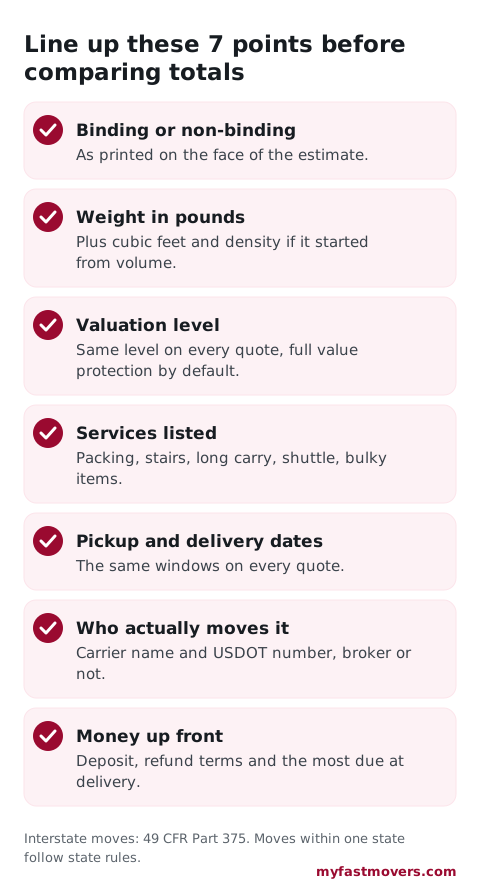
Step 2: Line up the seven points that move the price
Put the quotes in a table with one column per company and one row for each of these:
| Row | What to write down | Why it matters |
|---|---|---|
| Estimate type | Binding or non-binding, as printed on its face | A binding estimate fixes the price for what it lists (375.403); a non-binding one follows the scale |
| Weight | Estimated pounds, and the cubic feet and density if it started from volume | On a long-distance move the bill usually follows weight |
| Valuation | Full value protection or released value, and any deductible | Changes both the price and what you get back for damage |
| Services | Packing, materials, disassembly, stairs, long carry, shuttle, bulky items | Each is a separate charge if needed |
| Dates | Pickup window and delivery window | A tight window costs more to run |
| Who moves it | Company name and USDOT number of the carrier | The company on the quote may not be the one that shows up |
| Money up front | Deposit, its refund terms, and the most due at delivery | A deposit does not lower the price |
Two of these rows trip people up most often.
Weight. If a quote gives only cubic feet, ask for pounds. A non-binding estimate based on volume that will later be converted to a weight-based rate must come with a written explanation of the conversion formula (375.405). That formula, the density, is where two quotes for the same home part ways. How to read a moving estimate walks through the density arithmetic line by line.
Valuation. The federal booklet says the initial cost estimate you receive from your mover must include full value protection (Appendix A to Part 375). A quote priced at released value, 60 cents per pound per article, will look cheaper than one with full value protection, but it is not the same product. Ask every mover to quote the same level.
Step 3: Put every quote on the same weight
This is the step that changes the ranking. Here is a worked example with round, hypothetical numbers for a one-bedroom move of about 1,000 miles. None of these are real company quotes.
| Quote A | Quote B | Quote C | |
|---|---|---|---|
| Type | Binding | Non-binding | Non-binding |
| Estimated weight | 4,000 lb | 2,900 lb | 4,000 lb |
| Valuation | Full value | Released value only | Full value |
| Mover | Carrier | Broker | Carrier |
| Deposit | None | $1,000 | None |
| Total on the quote | $4,800 | $3,900 | $4,600 |
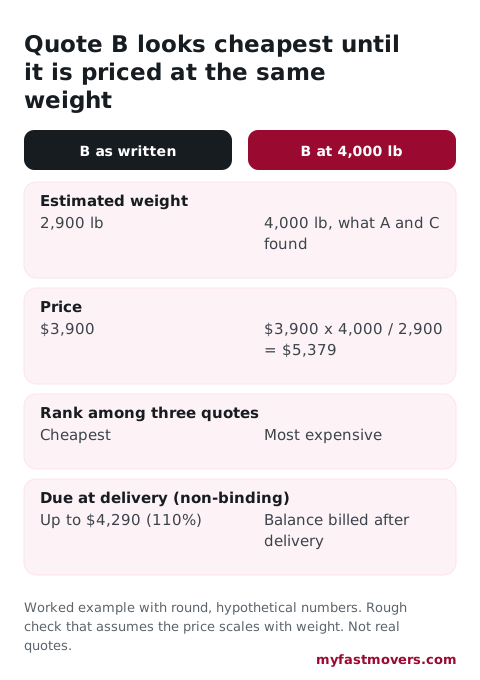
Quote B looks cheapest by $700 to $900. But it prices 1,100 fewer pounds than the other two, which surveyed the same home and agree with each other.
As a rough check, assume B’s price scales with weight. At 4,000 lb it becomes $3,900 × 4,000 ÷ 2,900 = $5,379, the most expensive of the three, and that is before adding full value protection, which B left out. Because B is non-binding, the most the mover can collect at delivery is 110 percent of the estimate, $3,900 × 1.10 = $4,290 (375.703). The rest, if the scale shows 4,000 lb, arrives as a bill after delivery.
A and C are the real comparison. C is $200 lower but non-binding, so it can rise with the scale weight; the most C can collect at delivery is $4,600 × 1.10 = $5,060. A is fixed at $4,800 for the goods and services it lists. Unless you are confident about the weight, A is the safer price.
For a neutral reference point, our moving cost calculator puts a 1,000-mile move of a small one-bedroom home with full-service movers at $4,050 to $5,400. It is a model estimate, not a quote, and it needs no phone number or email. A written estimate far below the model’s range is the one to read most carefully.
Step 4: Negotiate the right way
Movers price within their own tariffs, and there is room to ask. The asks below lower what you actually pay. Asking a mover to “sharpen the number” without changing anything else often just lowers the weight on paper, which you pay back at the scale.
- Ask for a match of a comparable quote. Show the higher mover a competing written estimate with the same weight, valuation and services, and ask if they will match or come closer. A match against a quote with a lower weight is not a real match.
- Ask for a binding price. If you like a non-binding quote, ask whether the mover will make it binding. A mover may offer a binding estimate if its tariff allows it (375.403) and may charge for writing one (375.401). Ask what the fee is and whether it is credited against the move.
- Offer flexible dates. Movers sell truck space, and a wider pickup window can help them fill a truck. We do not publish a figure for this because we cannot source one; just ask whether two or three possible pickup dates change the price. The demand side is explained in best time of year to move.
- Remove services you can do yourself. Packing, disassembly and materials are separate lines. Ask for a revised estimate without them.
- Move less. On a weight-based move, every item you sell or donate is weight you do not pay to ship. Declutter before you move shows what each room is worth.
- Ask about the deposit. There is no federal cap or ban on deposits; brokers must disclose their deposit, cancellation and refund policies (371.117). You can still ask for a smaller one, or none, and it is a fair tiebreaker between two similar quotes.
Whatever you agree, get it in a new written estimate before loading. If goods or services change, a mover must reaffirm its estimate or write a new one, signed by you, before loading (375.403 and 375.405). A discount promised on the phone does not appear on any of those documents.
What a lower price should not cost you
Walk away, or at least slow down, if a cheaper price comes with any of these:
- the estimated weight drops with no change to your inventory;
- full value protection disappears from the quote;
- “binding” or “guaranteed” is said on the phone but not printed on the estimate;
- the deposit goes up as the price goes down;
- the company on the new paperwork is not the one you have been talking to.
Each one moves cost or risk back to you later in the move.
Local moves: compare the hours, not the rate
Moves under about 100 miles are usually priced by the hour, so the rows change. Compare the crew size, the hourly rate, the minimum hours, the travel fee and how the mover counts time (door to door or on site only). A low hourly rate with a slow crew can cost more than a higher rate with a bigger one.
In our model, a two-bedroom local move takes a crew of 2 for 5 to 7 hours at $40 to $50 per mover per hour, plus a $75 travel fee: 2 × 5 × $40 + $75 = $475 at the low end and 2 × 7 × $50 + $75 = $775 at the high end. These are national model figures, not quotes; state pages scale them by local mover wages. Local moves are regulated by the state, so check your state’s rules for estimates and payment.
The short version
- Compare only written estimates made after a survey.
- Put every quote on the same weight, valuation, services and dates.
- Rank them on what you would pay at that weight, not on the printed total.
- Negotiate with a comparable match, a binding price, flexible dates or fewer services.
- Get every agreed change in a new written estimate before loading.
Questions people ask
Can you negotiate a moving quote?
Yes. Movers set their own prices within their tariffs, and many will sharpen a quote to win the job. The useful asks are a match of a comparable competing quote, a binding price instead of a non-binding one, flexible pickup dates, and fewer services. Whatever you agree, get it as a new written estimate before loading, because a phone promise does not change the paperwork.
Why is one moving quote so much cheaper than the others?
Usually because it prices less: a lower estimated weight, fewer services, released value instead of full value protection, or a non-binding estimate that will grow with the scale weight. Put every quote on the same weight and the same services, and the gap often closes or reverses. A quote with no survey behind it is a guess, not a price.
Should every moving quote include full value protection?
For interstate moves, yes. The federal booklet in Appendix A to 49 CFR Part 375 says the initial cost estimate you receive from your mover must include full value protection. A quote priced at released value, 60 cents per pound per article, is not comparable with one that includes full value protection, so ask for both quotes on the same level.
Is a binding moving quote always better than a non-binding one?
Not always, but it is easier to compare. A binding estimate fixes the price for the goods and services listed. A non-binding estimate follows the actual weight, with at most 110 percent of the estimate payable at delivery and the rest billed later. A binding quote a little higher than a non-binding one can still cost less in the end.
How many moving quotes should I get?
Enough to see an outlier, which in practice means at least three written estimates after a survey of your home, on-site or by video. With three weight guesses for the same inventory, the one far from the other two is the number to question. More quotes add calls without adding much information.
How this was written. Every cost figure in this article comes from the same published model that powers the calculator, so it cannot disagree with the tool. We do not operate trucks and nobody pays us for placement.
Sources
- 49 CFR 375.401, must I estimate charges? (eCFR) (www.ecfr.gov)
- 49 CFR 375.403, binding estimates (eCFR) (www.ecfr.gov)
- 49 CFR 375.405, non-binding estimates (eCFR) (www.ecfr.gov)
- 49 CFR 375.703, maximum collect-on-delivery amount (eCFR) (www.ecfr.gov)
- 49 CFR 371.113, broker estimates (eCFR) (www.ecfr.gov)
- 49 CFR 371.117, broker deposit and cancellation policies (eCFR) (www.ecfr.gov)
- Appendix A to Part 375, Your Rights and Responsibilities When You Move (eCFR) (www.ecfr.gov)