

Virtual Moving Estimates: How to Get One That Holds
A video survey counts as a physical survey for interstate moves. How to run one so the price holds, and what the rules allow if the price changes on moving day.
Published November 3, 2026 · 8 min read · By My Fast Movers
In short
A virtual moving estimate is a survey done by live or recorded video, and for interstate moves it counts as the physical survey the rules require. Show every room, closet, garage and attic, open cabinets, name what stays, and get a signed written estimate that says binding or non-binding. Any price change must be agreed in writing before loading.
A virtual moving estimate is a survey of your home done by live or pre-recorded video, and for an interstate move it counts as the physical survey federal rules require. It holds only as well as the video: show every room and storage space, say what stays, and get a signed, written estimate that says binding or non-binding. Any change to the price must be agreed in writing before your goods are loaded.
A common complaint right now goes like this: the quote came from a quick video call, and on moving day the crew walked through, measured the load in cubic feet and named a much higher price. This guide shows how to run a video survey so that does not happen, and what the rules let a mover do if it still tries.
The rules below are the federal ones for interstate household moves (49 CFR Part 375). A move that starts and ends in one state follows that state’s rules instead.
What the rules say a video survey is
An interstate mover must do a physical survey of your goods and give you a written estimate based on it (375.401). The definition of a physical survey covers video: it can be “conducted on-site or virtually”, and a virtual survey must let the mover view the goods “through live or pre-recorded video that allows it to clearly identify the household goods to be transported” (375.103).
Three things follow from that:
- A video survey is not a lesser estimate. The written estimate built on it is held to the same rules as one written after a home visit.
- The video has to be good enough to identify your goods. A call that skips the garage or pans past closed closet doors does not show the mover what it is pricing.
- No survey at all needs your signature. You can waive the survey, but only in writing and signed before loading (375.401(a)). A number read off a web form, with no survey and no waiver, is not the estimate the rule describes. FMCSA lists an estimate given by phone or online, sight unseen, among its red flags.
If a broker sends you the estimate, the same applies: a broker’s written estimate must be based on a physical survey by the carrier that will move you, unless you waive it in writing (371.113). See moving broker vs carrier to tell which one you are dealing with.
Before the call: get ready in 30 minutes
Most moving-day re-quotes start with something the video never showed. A short prep closes those gaps.
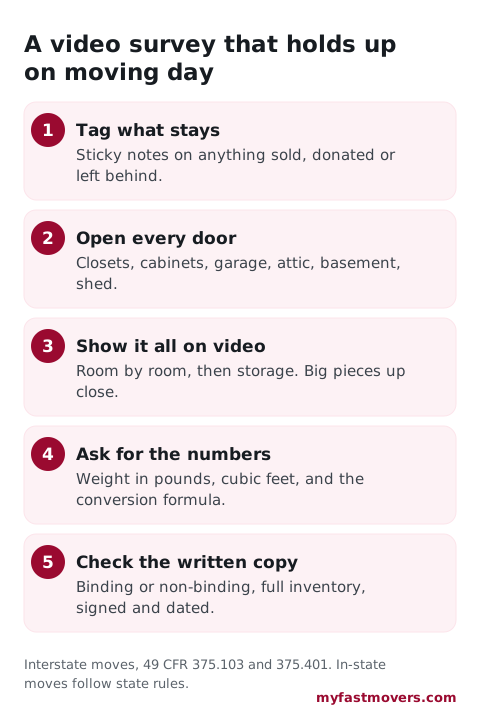
- Decide what is not coming. Put a sticky note on anything you are selling, donating or leaving. Every item you are unsure about should be counted as coming.
- Open every door. Closets, cabinets, the pantry, the garage, the attic hatch, the shed. Pull out under-bed storage.
- List what is not in the house. A storage unit, a parent’s garage, a patio set, a boat or a gym set in the basement all need to be on the estimate.
- Know your access. Count the stairs, note the elevator and any booking rules, and check how close a truck can park at both ends.
- Charge the phone and test the connection in the room with the weakest signal, often the basement or garage.
During the call: what to show and say
Walk the home in one direction so nothing gets skipped, and talk as you go.
- Go room by room, then storage. Living spaces first, then every closet, then garage, attic, basement and outdoor areas.
- Show the big and heavy pieces up close. Name what comes apart (bed frames, tables, desks) and what does not (a piano, a gun safe, a large sectional).
- Show box contents, not only boxes. A shelf of books weighs far more than a shelf of bedding of the same size.
- Say what stays. “The fridge stays. The couch is sold.” Then make sure the written inventory agrees.
- Ask what they cannot see. Before you hang up, ask the estimator: “Is there anything you could not see clearly?” Fix it on the call.
- Ask for the numbers behind the price. The estimated weight in pounds, the volume in cubic feet, and, if the price starts from volume, how volume becomes weight.
The last point matters. If a mover gives an estimate based on volume that will later be converted to a weight-based rate, it must explain the conversion formula to you in writing (375.401(e)). On a non-binding estimate, the final charges are based on the actual weight of your shipment and the mover’s tariff (375.401(b)(2)). How to read a moving estimate shows how the conversion works.
Worked example, round numbers: a quote says 900 cubic feet. At 7 pounds per cubic foot that is 6,300 pounds; at 5 pounds per cubic foot it is 4,500 pounds. Same goods, 1,800 pounds apart on paper. Ask which density the quote used.
After the call: what the written estimate must show
The video is only the survey. The estimate is the document that protects you. Check it against this list before you sign:
| Check | Where the rule is |
|---|---|
| It says binding or non-binding on its face | 375.401(b), 375.403(a)(4), 375.405(b)(5) |
| A non-binding estimate says you pay no more than 110 percent at delivery | 375.405(b)(5) |
| The inventory matches what you showed, including the garage and storage | 375.403(a)(5), 375.405(b)(6) |
| Stairs, elevator, long carry and other extras are priced now | 375.401(f) |
| A volume-based price comes with the written conversion formula | 375.401(e) |
| The accepted forms of payment at delivery are listed | 375.401(c) |
| You and the mover both sign it, and you get a dated copy | 375.401(h) |
A non-binding estimate must be free. A mover may charge for a written binding estimate (375.401(b)(1)). For which one to choose, see binding vs non-binding moving estimates.
When a new price shows up on moving day
This is the situation people report most: the crew arrives, looks around and announces a new figure. Here is what the rules allow, in order.
Before loading. If it appears you have more goods, or need services the estimate did not list, the mover is not required to honor the estimate. It can reaffirm the estimate, or write a new one that lists the added goods or services in detail and that you sign. On a binding estimate there is a third option: both sides agree in writing to treat it as non-binding (375.403(a)(6), 375.405(b)(7)). The estimate can also be amended by mutual agreement before loading (375.401(i)).
That means:
- Ask what changed, item by item. A new estimate must list the additional goods or services. “It looks bigger” is not a list.
- You can say no. If you do not agree, the mover is not required to take the shipment. It cannot load your goods on the old paper and bill you on a new number.
- Do not sign blank or half-filled papers. FMCSA lists blank documents among its red flags, along with a mover that claims you have more belongings than estimated.
After loading. The estimate cannot be amended once the shipment is loaded (375.401(i)). If the mover loads without writing a new estimate, it has reaffirmed the original one (375.403(a)(7), 375.405(b)(8)).
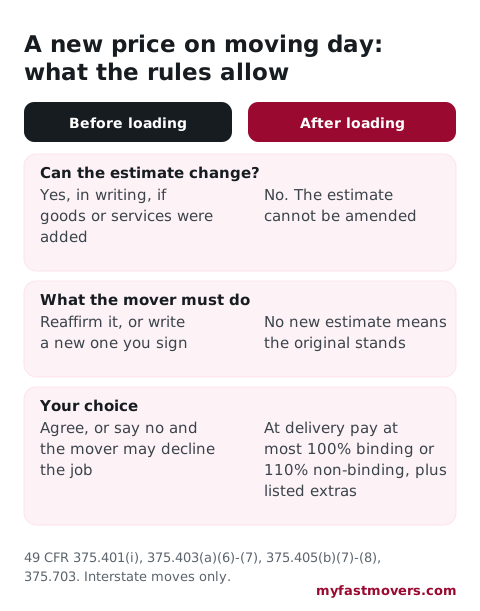
At delivery. The most the mover can demand before unloading is 100 percent of a binding estimate or 110 percent of a non-binding one, plus services you asked for after the bill of lading and certain impracticable-operation charges (375.703). Worked example, round numbers: on a $5,000 non-binding estimate, the most due at the door for the estimated services is $5,500 ($5,000 × 1.10). The rest is billed later.
If a crew will not unload until you pay more than that, follow what to do when movers hold your belongings.
Red flags in a virtual estimate
- The call lasted a few minutes and never left the living room.
- The estimator did not ask about the garage, attic, basement or storage.
- The price is quoted only in cubic feet, with no weight and no conversion formula.
- The estimate does not say binding or non-binding.
- You were asked for a large deposit before any written estimate.
- The company on the estimate is not the one you called, and nobody explained why.
Before you book, check the mover’s registration in two minutes with how to check a mover’s USDOT number.
Get a neutral number first
A video estimate is easier to judge when you already have a rough figure for your move. The moving cost calculator gives a model estimate from home size and distance with no phone number required. It is not a quote. Its use is simple: a written estimate far below it, or a moving-day price far above the estimate, is the one to question in writing.
Questions people ask
Is a video estimate as valid as an in-home estimate?
For interstate moves, yes. 49 CFR 375.103 defines a physical survey as one conducted on-site or virtually, and a virtual survey must let the mover clearly identify the goods through live or pre-recorded video. The written estimate built on it carries the same rules as one written after a home visit.
Can movers change a virtual estimate on moving day?
Only before loading. If you have more goods or need services the estimate did not list, the mover does not have to honor it, but it must reaffirm the estimate or write a new one that you sign before loading. You may also refuse the new price. After loading, the estimate cannot be amended, and failing to write a new one means the original stands.
What should I show the mover on a video survey?
Everything that will go on the truck: every room, closets with doors open, cabinets, the garage, attic, basement, shed, patio and any storage unit. Point out heavy or bulky items, items that come apart, stairs and elevators, and how close a truck can park. Say clearly what stays behind, then check that the written inventory matches.
Can a mover charge me for a virtual estimate?
A non-binding estimate must be free. A mover may charge for a written binding estimate under 49 CFR 375.401. Ask before the video call whether there is a fee and whether it is credited against the move.
Do these rules apply to a move within my state?
No. 49 CFR Part 375 covers interstate household goods moves. A move that starts and ends in one state follows that state's rules, which can differ on surveys, estimates and what a mover may charge. Check your state's transportation or consumer protection agency.
How this was written. Every cost figure in this article comes from the same published model that powers the calculator, so it cannot disagree with the tool. We do not operate trucks and nobody pays us for placement.
Sources
- 49 CFR 375.103, definitions incl. physical survey (eCFR) (www.ecfr.gov)
- 49 CFR 375.401, must I estimate charges? (eCFR) (www.ecfr.gov)
- 49 CFR 375.403, binding estimates (eCFR) (www.ecfr.gov)
- 49 CFR 375.405, non-binding estimates (eCFR) (www.ecfr.gov)
- 49 CFR 375.703, maximum collect-on-delivery amount (eCFR) (www.ecfr.gov)
- 49 CFR 371.113, broker estimates (eCFR) (www.ecfr.gov)
- FMCSA Protect Your Move: red flags (www.fmcsa.dot.gov)