

Moving Bill of Lading: What to Check Before You Sign
The bill of lading is your moving contract. The 17 items it must list, the 3-day rule before loading, what never to sign and the copies to keep.
Published November 6, 2026 · 8 min read · By My Fast Movers
In short
The bill of lading is your interstate moving contract. Before signing, check the mover's registered name and USDOT number, the pickup and delivery dates, the maximum due at delivery, your valuation choice and the attached estimate and inventory. Federal rules say you sign it at least 3 days before loading and may cancel within 3 days.
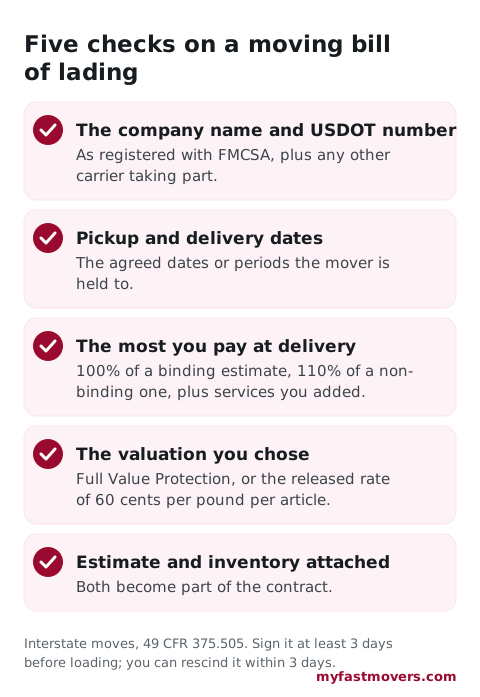
The bill of lading is the contract for your move, so read it before you sign, not while the crew waits. On an interstate move, check five things: the mover’s registered name and USDOT number, the pickup and delivery dates, the maximum you must pay at delivery, the valuation you chose, and that the estimate and inventory are attached. Federal rules say you should get it at least 3 days before loading, and you can cancel it within 3 days of signing without penalty.
Most moving-day disputes come down to one sheet of paper. When a price jumps, a delivery runs weeks late, or a damage claim is declined, the first question anyone asks is “what does your bill of lading say?” Many people only see it for the first time at the truck, with the crew waiting, and sign where they are told.
This guide covers what the bill of lading must contain, when you sign it, what never to sign, and which copies to keep. The rules quoted are federal rules for interstate household goods moves (49 CFR Part 375). A move that stays inside one state follows that state’s rules.
What the bill of lading is
It does two jobs. It is your contract with the mover: section 375.505(a) says it “must contain the terms and conditions of the contract”. It is also the receipt for your goods, signed when they leave your home and again when they arrive.
Two documents attach to it and become part of the contract (375.505(b)(15)):
- The estimate, binding or non-binding. If you have not checked it yet, how to read a moving estimate goes through it line by line.
- The inventory, the numbered list of every carton and loose item (375.503).
The bill of lading must also say that it includes by reference all the services listed on the estimate (375.505(b)(17)). So a service promised on the estimate is part of the contract even if the bill of lading does not repeat it.
The 3-day rule: sign it before moving day
This is the rule fewest people know about. Under 375.505(h):
- The mover must give you the bill of lading to sign and date at least 3 days before your shipment is scheduled to be loaded.
- After you sign, you have 3 days to rescind it without any penalty.
- If you add items or services on moving day and the mover writes a new estimate under the binding or non-binding rules, the changes that follow on the bill of lading do not start a new 3-day period.
Ask for the bill of lading early. Read it at home, with the estimate next to it. If a company says you will only see it when the truck arrives, ask in writing why. Write the date you received it on your copy.
The 17 items it must contain
Section 375.505(b) lists 17 required items. These are the ones that matter most when something goes wrong:
| What to find | Why it matters | Rule |
|---|---|---|
| The mover’s legal or trade name as registered with FMCSA, and its physical address | This is the company you can claim against. It should match the USDOT record. | 375.505(b)(1) |
| Names, phone numbers, addresses and USDOT numbers of any other carriers taking part, when known | Tells you if your goods are handed to another company | 375.505(b)(2) |
| The form of payment accepted at delivery, the same as on the estimate | Stops a “cash only” surprise at the door | 375.505(b)(4) |
| The agreed pickup and delivery dates or periods | The dates the mover is held to. Guaranteed service also lists any per-day penalty owed to you. | 375.505(b)(6), (7) |
| The actual pickup date | Starts the clock on the delivery period | 375.505(b)(8) |
| The terms for paying the total charges, with any minimum charges | Shows what is due and when | 375.505(b)(10) |
| The maximum amount due at delivery to get your goods | The number you hold up if a crew asks for more | 375.505(b)(11) |
| The valuation statement: Full Value Protection or the released rate | Decides what you get back if something is damaged or lost | 375.505(b)(12) |
| Every special or accessorial service ordered, and any minimum weight or volume charges | Extra fees must be described here, not invented later | 375.505(b)(14) |
| The estimate and the inventory as attachments | Makes both part of the contract | 375.505(b)(15) |
To check the name and USDOT number against the FMCSA register, see how to check a mover’s USDOT number. If the name on the bill of lading is not the company you booked with, you may have booked through a broker. Moving broker vs carrier explains the difference.
The number to circle: the most you pay at delivery
On a collect-on-delivery move, item 11 is the maximum the mover will demand at delivery to release your goods. Under 375.703, that is:
- Binding estimate: 100 percent of the estimate.
- Non-binding estimate: 110 percent of the estimate.
- Plus charges for services you asked for after the bill of lading was issued, and certain impracticable-operation charges (up to 15 percent of the other charges).
Worked example (round numbers): a non-binding estimate of $5,000 for transportation and listed services. The most the mover can require at the door for those is $5,000 × 1.10 = $5,500. Anything above that is billed later, and Appendix A says remaining charges are billed after 30 days from delivery.
If the maximum on the bill of lading is blank, or does not match this arithmetic, ask for it to be corrected before you sign. If a crew asks for more than this figure before unloading, see what to do when movers hold your belongings.
Valuation: the line people skip
Item 12 is the valuation statement. You either choose Full Value Protection or waive it in writing for the released rate, which Appendix A sets at 60 cents per pound per article. A 50-pound television valued at the released rate would bring back at most 50 × $0.60 = $30, whatever it cost.
Check which box is ticked and that the charge for it, if any, is shown. If you bought separate insurance from an independent insurer through the mover, the bill of lading must show that coverage and its premium (375.505(b)(13)). Moving insurance vs valuation explains the choice.
What you should never sign
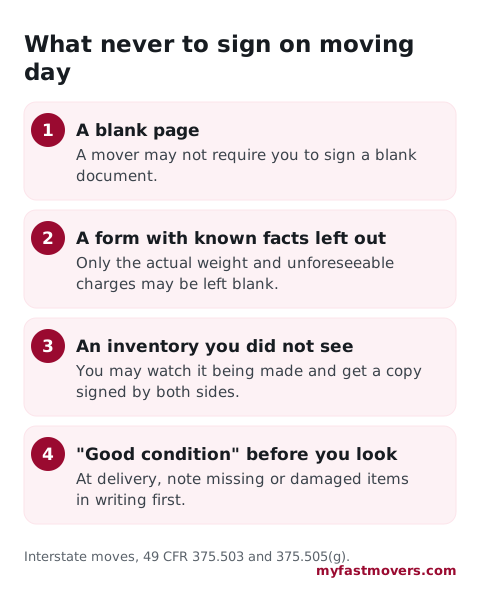
- A blank document. A mover may not require you to sign one (375.505(g)(3)). FMCSA’s red-flag list includes a mover that asks you to sign blank documents.
- An incomplete document, unless only the unknowns are missing. Before loading, a mover may ask you to sign an incomplete document only if everything is filled in except what cannot be known yet, such as the actual weight on a non-binding estimate or charges that come up in transit (375.505(g)(2)).
- An inventory you have not seen. The mover must give you the chance to watch and check the inventory as it is made, and give you a copy signed by both of you, with the bill of lading, before or at loading (375.503(b), (c)).
- “Received in good condition” at delivery before you have looked. At delivery the mover must let you check that the same items arrived, and note in writing anything missing or damaged, and give you a copy of those notes (375.503(d)). Those notes are where a damage claim starts. How to file a moving damage claim covers the next steps.
On moving day: the sign-and-keep checklist
- Compare the bill of lading with the copy you signed 3 days earlier. Any new item or service should come from a new written estimate, not a handwritten line.
- Check the truck. The bill of lading must show the identification number of the vehicle your goods are loaded on (375.505(b)(9)). Write it down if it is blank.
- Watch the inventory. Check the item numbers and the condition codes, and write your own note beside any you disagree with before you sign.
- Ask how the weight will be found. If the estimate was by volume and converted to weight, the mover must explain the conversion in writing (375.507(c)).
- Take a dated copy. The mover must give you a dated copy when you sign (375.505(f)). Photograph every page too.
- At delivery, sign again only after checking. The bill of lading is signed at origin and at destination (375.505(f)).
Keep the bill of lading, the estimate, the inventory and every delivery note together until any claim is settled. With the booklets the mover must give you with the estimate (375.213), they are the record of what was promised.
If the mover will not follow the rules
If a mover will not give you the bill of lading before moving day, asks you to sign blank pages, or demands more than the maximum on it, say so in writing and keep the reply. You can file a complaint with FMCSA through the National Consumer Complaint Database. FMCSA says it cannot resolve claims against a mover, but complaints are shown in its mover search, which helps the next customer.
Before you book, get a neutral price for your move from the moving cost calculator. It needs no phone number and shows how the number is built. It is a model estimate, not a quote. A bill of lading far above it, or an estimate far below it, is the one to read most carefully.
Questions people ask
What is a bill of lading for a move?
It is the contract between you and the mover, and the receipt for your goods. For interstate moves, 49 CFR 375.505 says the mover must prepare it before taking your shipment, it must contain the terms of the contract and 17 listed items, and both of you sign it before loading and again at delivery. The estimate and the inventory are attached and become part of it.
When do I have to sign the bill of lading?
Under 49 CFR 375.505(h), the mover must give you the bill of lading to sign and date at least 3 days before the shipment is scheduled to be loaded. You then have 3 days after signing to rescind it without penalty. If you add items or services on moving day, the changes from the new estimate do not start a new 3-day period.
Can movers make me sign a blank bill of lading?
No. A mover may not require you to sign a blank document (375.505(g)(3)). It may ask you to sign an incomplete one before loading only if everything is filled in except what cannot be known yet, such as the actual weight on a non-binding estimate. FMCSA lists being asked to sign blank documents as a red flag.
What should the bill of lading say about payment?
It must state the form of payment accepted at delivery, the same one shown on the estimate, the terms for paying the total charges, and on a collect-on-delivery move the maximum amount the mover will demand at delivery to release your goods. That maximum is 100 percent of a binding estimate or 110 percent of a non-binding one, plus services you added later (375.703).
Do these rules apply to a local move?
The rules in 49 CFR Part 375 cover interstate household goods moves. A move that stays inside one state follows that state's rules, which may require different paperwork or none. Even so, the same checks are worth doing on any moving contract: the company name, the price terms, the dates, the coverage and a signed copy you keep.
How this was written. Every cost figure in this article comes from the same published model that powers the calculator, so it cannot disagree with the tool. We do not operate trucks and nobody pays us for placement.
Sources
- 49 CFR 375.505, must I write up a bill of lading? (eCFR) (www.ecfr.gov)
- 49 CFR 375.503, must I write up an inventory? (eCFR) (www.ecfr.gov)
- 49 CFR 375.507, must I determine the weight of a shipment? (eCFR) (www.ecfr.gov)
- 49 CFR 375.213, information for prospective shippers (eCFR) (www.ecfr.gov)
- 49 CFR 375.403, binding estimates (eCFR) (www.ecfr.gov)
- 49 CFR 375.703, maximum collect-on-delivery amount (eCFR) (www.ecfr.gov)
- Appendix A to Part 375, Your Rights and Responsibilities When You Move (eCFR) (www.ecfr.gov)
- FMCSA Protect Your Move, spot the red flags (www.fmcsa.dot.gov)
- FMCSA National Consumer Complaint Database (complaint.fmcsa.dot.gov)