

How to Check a Mover's USDOT Number in Two Minutes
Check any interstate mover in FMCSA's register before you pay: USDOT and MC numbers, carrier or broker, registration status, complaints and safety.
Published October 27, 2026 · 8 min read · By My Fast Movers
In short
Ask the mover for its USDOT number, then look it up in FMCSA's mover search on the Protect Your Move site. Confirm the name and address match, that it is registered as a carrier rather than only a broker, that its registration is active, and read its complaints and safety record. A mover that will not give you the number is the answer.
Ask the mover for its USDOT number and look it up in FMCSA’s mover search before you pay anything. In two minutes you can confirm that the company is registered, whether it is a carrier or a broker, and what its complaint and safety record looks like. A mover that will not give you its number has answered the question for you.
FMCSA puts it plainly: “Interstate movers must be registered with the Federal government and have a U.S. DOT number.” For moves within one state, requirements vary by state.
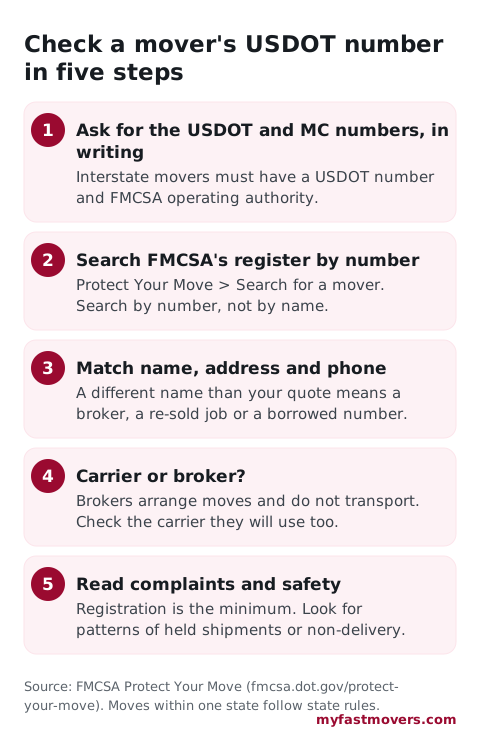
Step 1: Get the numbers
Ask for two numbers, in writing:
- USDOT number: the company’s ID in the federal register.
- MC number: its operating authority to move household goods across state lines for hire, or to act as a broker. FMCSA says interstate moving companies “must obtain operating authority from FMCSA to perform household goods moves.”
A legitimate mover gives both without fuss, and they should also be on its website, quotes and trucks. Brokers must show their numbers in their ads too (371.107).
Step 2: Look it up in FMCSA’s register
Go to FMCSA’s search for a mover page on the Protect Your Move site. You can search by name, USDOT number or MC number. FMCSA lists what the search shows:
- headquarters location and contact information;
- registration status;
- type of moving business: carrier, broker, freight forwarder;
- complaint information;
- safety information.
Search by number, not name. Rogue movers often trade on names that sound like well-known ones.
Step 3: Match it to the company you spoke to
Most problems show up here, not in the safety data.
- Name. Does the legal or trade name match the company on your quote and website? A different name means a broker, a re-sold job, or a company borrowing someone else’s number.
- Address. Is there a real business address? FMCSA’s red-flag list includes a website with “no local address and no information about their registration or insurance.”
- Phone. Does the number match? FMCSA also flags a company that answers the phone with a generic “Movers” or “Moving Company” instead of its name.
Step 4: Carrier or broker?
The search shows the type of business. Both are legal, but you should know which you are hiring.
- A carrier owns or operates the trucks and does the move.
- A broker arranges the move and hands it to a carrier. Brokers must say prominently that they are household goods brokers and will not transport your goods (371.107), and must give you a list of the carriers they use.
If you book through a broker, ask which carrier will do the move and check that carrier too. On moving day, the bill of lading must show the USDOT number of every carrier taking part (375.505). Moving broker vs carrier explains how the two work.
Step 5: Read the record, not just the status
“Registered” is the minimum. Then look at:
- Complaints: read what they are about, not only how many there are. A pattern of complaints about held shipments, price changes or non-delivery is the warning sign.
- Safety information: roadside inspections and out-of-service orders show how the company runs its trucks.
- How long it has been registered: a brand-new registration with a polished website deserves extra questions.
A faster way for the movers in our directory
Every carrier in our directory has a page built from the same FMCSA register. Our snapshot is dated September 24, 2026, and the inspection data covers 24 months. Each page shows:
- the USDOT and MC numbers and the type of authority;
- the fleet and driver counts from the carrier’s own filing;
- the safety rating, if FMCSA has rated it;
- roadside inspections over the last 24 months, compared with movers nearby;
- a link to the carrier’s live FMCSA record.
Start from movers by state. Always confirm the live record on FMCSA before you pay, because registrations change daily.
Red flags you can spot while checking
These come from FMCSA’s own red flags list:
- no on-site inspection, with the estimate given “sight unseen”;
- a demand for cash or “a large deposit before the move”;
- a request to sign blank documents;
- no copy of the booklets “Your Rights and Responsibilities When You Move” and “Ready to Move”;
- a claim that you have more belongings than estimated, after loading.
More on how these scams run is in moving scams: 9 red flags. If it is already happening, see movers holding your belongings hostage.
If something is wrong
Report it: online at complaint.fmcsa.dot.gov or by phone at 1-888-DOT-SAFT (1-888-368-7238). For a move within one state, contact your state’s consumer affairs agency or attorney general. Then pick a different mover and get a neutral price from the moving cost calculator to judge the next quote against.
Questions people ask
Do all movers need a USDOT number?
Interstate movers do. FMCSA says a U.S. DOT number is required for interstate moves, and that interstate moving companies must also obtain operating authority from FMCSA to perform household goods moves. For moves within one state, requirements vary; check with your state, county or local consumer affairs agency or your state attorney general.
What is the difference between a USDOT number and an MC number?
The USDOT number identifies the company in FMCSA's register. The MC number is the docket number for its operating authority, the permission to haul household goods across state lines for hire, or to act as a broker. An interstate mover should have both, and brokers must show their MC number in their advertising.
How do I know if a moving company is a broker?
FMCSA's mover search shows the type of moving business: carrier, broker or freight forwarder. Brokers must also say on their website and in ads that they are household goods brokers and will not transport your goods, and must give you a list of the carriers they use with their USDOT and MC numbers.
Where can I see complaints against a moving company?
FMCSA's mover search on the Protect Your Move site shows complaint information alongside registration and safety information. You can file a complaint yourself online at complaint.fmcsa.dot.gov or by phone at 1-888-DOT-SAFT (1-888-368-7238).
Is a USDOT number proof that a mover is good?
No. It proves the company is registered, not that it treats customers well. Read the complaint history and the roadside inspection record, check that the name and address match the company you spoke to, and get a written estimate based on a survey. Registration is the minimum, not the verdict.
How this was written. Every cost figure in this article comes from the same published model that powers the calculator, so it cannot disagree with the tool. We do not operate trucks and nobody pays us for placement.
Sources
- FMCSA Protect Your Move, search for a mover (www.fmcsa.dot.gov)
- FMCSA Protect Your Move, how to select a mover (www.fmcsa.dot.gov)
- FMCSA Protect Your Move, movers vs brokers (www.fmcsa.dot.gov)
- FMCSA Protect Your Move, red flags (www.fmcsa.dot.gov)
- FMCSA Protect Your Move, frequently asked questions (www.fmcsa.dot.gov)
- 49 CFR 371.107, broker advertising (eCFR) (www.ecfr.gov)
- 49 CFR 375.505, contents of the bill of lading (eCFR) (www.ecfr.gov)