

Movers Holding Your Belongings Hostage: What to Do Now
Your mover raised the price and won't unload until you pay. What federal rules make the mover accept, what to say, what to pay, and who to call, step by step.
Published October 27, 2026 · 8 min read · By My Fast Movers
In short
Check your bill of lading. On an interstate move, the mover must release your goods once you pay 100 percent of a binding estimate or 110 percent of a non-binding one, plus services you added. Offer that amount in writing, ask for the weight tickets and a reweigh, file a federal complaint and contact your state attorney general if they refuse.
If your mover has raised the price and will not unload, check the bill of lading first. On an interstate move the mover must release your goods once you pay 100 percent of a binding estimate or 110 percent of a non-binding one, plus charges for services you added. Offer that amount in writing, ask for the weight tickets and a reweigh, and if they still refuse, file a federal complaint and contact your state attorney general.
This is the “hostage load”. It starts with a low quote and a large deposit. Once the truck is full, the price changes, often on a claim that your goods weigh far more than estimated. It works because everything you own is already on the truck. The rules below are your leverage, so keep this page open on your phone.
These are the federal rules for interstate household moves (49 CFR Part 375). If your move stays inside one state, state rules apply; the steps still help, but check your state’s agency.
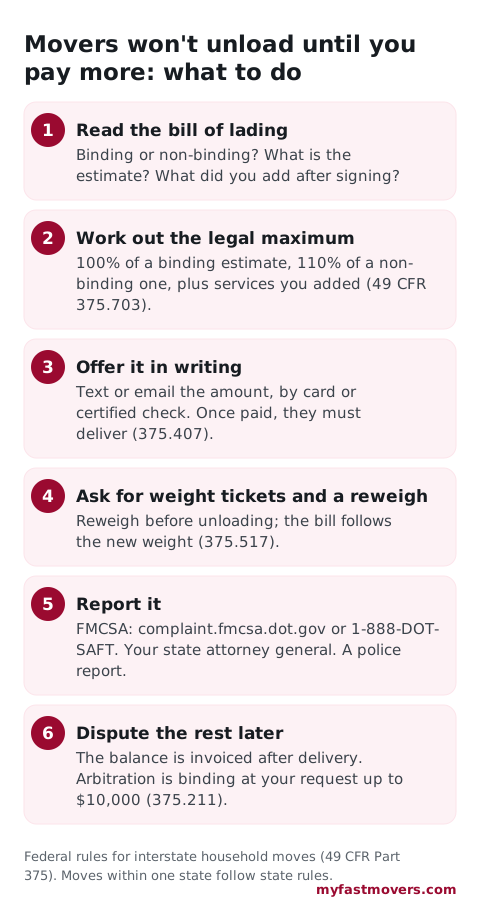
Step 1: Find three numbers on your paperwork
Get the bill of lading and the estimate. The bill of lading must list “the maximum amount” due at delivery (375.505), and you need three things from it:
- Binding or non-binding. A binding estimate must say so on its face.
- The estimate amount for the services on it.
- Services added after the bill of lading, such as extra packing you asked for on the day.
Step 2: Work out what you actually owe at delivery
Federal rules set the most a mover can collect before handing over your shipment (375.703):
| Your estimate | Most you must pay at delivery |
|---|---|
| Binding | The exact estimate |
| Non-binding | 110% of the estimate |
| Both | Plus services you requested after the bill of lading, and impracticable-operation charges capped at 15% |
Worked example: a non-binding estimate of $3,000 means the most you can be made to pay at the door for those services is $3,000 × 1.10 = $3,300.
Once you pay that, the mover “must relinquish possession of the shipment” (375.407). Refusing counts as failing to deliver with reasonable dispatch. Any remaining charges are billed afterwards: the mover has to send an invoice within 15 business days (375.807), and the federal booklet says the balance is billed after 30 days from delivery. You can dispute that invoice. You do not settle it in the driveway.
Step 3: Say it, in writing
Text or email the dispatcher and the driver, and keep the reply. Something like:
“My bill of lading [number] shows a non-binding estimate of $[X]. Under 49 CFR 375.407 and 375.703 I am offering $[1.10 × X], which is 110 percent, by [card / certified check]. Please confirm delivery today. Please send true copies of all weight tickets, and I request a reweigh before unloading under 49 CFR 375.517.”
Written words do two things: they show you offered what the rules require, and they create the record that a complaint, the police and an arbitrator will ask for.
Step 4: Challenge the weight
Most hostage loads ride on a weight that jumped.
- Weight tickets. Every freight bill must come with true copies of all weight tickets (375.519). Ask for them.
- Reweigh. Before unloading begins you can demand a reweigh, and the bill must be based on the new weight (375.517). The federal booklet says the mover may not charge you for it.
- Your right to watch. You may observe every weighing (375.513).
If the “real” weight is far above the estimate for the same home, the reweigh is where that gets tested.
Step 5: If they still refuse
- File a complaint with FMCSA, online at complaint.fmcsa.dot.gov or by phone at 1-888-DOT-SAFT (1-888-368-7238), weekdays 8am to 8pm Eastern. FMCSA’s own guidance says that a mover that fails to deliver after you paid 110 percent of a non-binding estimate, or 100 percent of a binding one, has violated federal regulations. Its April 2023 enforcement sweep, Operation Protect Your Move, targeted movers holding possessions hostage.
- Contact your state attorney general or the state enforcement agency, at the origin and the destination. FMCSA lists them by state on its state law enforcement page.
- Make a police report with the local non-emergency line, showing the bill of lading and your written offer. A report puts the refusal on an official record that the complaint and any court case can point to.
- Ask for arbitration on the extra charges. Interstate movers must offer arbitration for disputes about charges added after delivery, as well as loss and damage (375.211). It is binding at your request for amounts of $10,000 or less.
If you pay more to get your things back
Sometimes people pay because they need the crib or the medicine tonight. If you do:
- pay by credit card, not cash, wire or a payment app;
- write “paid under protest” on the bill of lading and the receipt, and say so in a text as well;
- photograph every page you sign;
- then use the complaint and arbitration routes above to recover the overcharge, and ask your card issuer about a dispute.
How the next move avoids this
Most hostage loads can be spotted before booking. The warning signs, in order of how often they show up:
- a quote with no survey;
- a large deposit by wire or app;
- a quote in cubic feet;
- a company name that changes between the website and the paperwork.
Moving scams: 9 red flags covers them in full. How to check a mover’s USDOT number takes two minutes. How to read a moving estimate shows where the binding and 110 percent lines sit on the paperwork. A neutral figure from the moving cost calculator tells you when a quote is too low to be true.
Questions people ask
Can movers legally hold my belongings until I pay more?
On an interstate move, not beyond the federal limit. Under 49 CFR 375.407 and 375.703, once you pay 110 percent of a non-binding estimate (or 100 percent of a binding one), plus charges for services you requested after the bill of lading and certain impracticable-operation charges, the mover must hand over your shipment. Holding it for more counts as failing to deliver with reasonable dispatch.
What is the 110 percent rule for movers?
It caps what an interstate mover can collect at delivery on a non-binding estimate: 110 percent of the estimate, plus extras you asked for after the bill of lading was issued and up to 15 percent for impracticable operations. Anything above that is billed afterwards, and the mover must present the invoice within 15 business days; you can dispute it then.
Should I pay the extra money to get my things back?
Pay what the rules require, not what is demanded. Offer the 100 or 110 percent amount in writing, by a payment method that leaves a record. If the mover still refuses, file a complaint with FMCSA and your state attorney general rather than paying cash on the spot. If you decide to pay more to get urgent items, pay by card, write 'paid under protest' on the paperwork and keep every receipt.
Can I ask the movers to reweigh my shipment?
Yes. Before unloading starts you can demand a reweigh, and the bill must then be based on the reweigh weight (49 CFR 375.517). The federal booklet says the mover may not charge for the reweigh. You also have the right to watch every weighing, and every freight bill must come with true copies of the weight tickets.
Does the 110 percent rule apply to local moves?
The federal rules in 49 CFR Part 375 cover interstate household goods moves. A move inside one state is regulated by that state, and the rules differ. Many states have their own tariff and release rules; check your state's transportation, public utility or consumer protection agency.
How this was written. Every cost figure in this article comes from the same published model that powers the calculator, so it cannot disagree with the tool. We do not operate trucks and nobody pays us for placement.
Sources
- 49 CFR 375.407, relinquishing possession of a shipment (eCFR) (www.ecfr.gov)
- 49 CFR 375.703, maximum collect-on-delivery amount (eCFR) (www.ecfr.gov)
- 49 CFR 375.517, the reweigh (eCFR) (www.ecfr.gov)
- 49 CFR 375.519, weight tickets on the freight bill (eCFR) (www.ecfr.gov)
- 49 CFR 375.505, contents of the bill of lading (eCFR) (www.ecfr.gov)
- 49 CFR 375.807, invoicing and credit period (eCFR) (www.ecfr.gov)
- 49 CFR 375.211, arbitration (eCFR) (www.ecfr.gov)
- Appendix A to Part 375, Your Rights and Responsibilities When You Move (eCFR) (www.ecfr.gov)
- FMCSA Protect Your Move, frequently asked questions (www.fmcsa.dot.gov)
- FMCSA Protect Your Move, what if I have problems with my move (www.fmcsa.dot.gov)
- FMCSA launches Operation Protect Your Move (April 4, 2023) (www.fmcsa.dot.gov)