

How to File a Moving Damage Claim (Steps and Letter)
Interstate moving damage claims step by step: what to note at delivery, what the written claim must say, the 9-month and 120-day clocks, and a letter to copy.
Published October 27, 2026 · 9 min read · By My Fast Movers
In short
Note every damaged or missing item on the delivery paperwork, photograph it, then send the mover a written claim that identifies the shipment, says the mover is liable and asks for a specific amount. Interstate movers must give you at least 9 months to file, acknowledge the claim within 30 days and pay, decline or offer a settlement within 120 days.
To file a moving damage claim, note the damage on the delivery paperwork, photograph it, and send the mover a written claim that names the shipment, says the mover is liable and asks for a specific amount. On an interstate move the mover must give you at least 9 months to file, acknowledge your claim within 30 days and answer it within 120 days.
Most denied claims fail on paperwork, not on the damage itself: no note at delivery, no photos, a phone call instead of a written claim, or a claim filed after the deadline. This guide is the order of operations, with the federal rules for interstate moves. Moves inside one state follow that state’s rules.
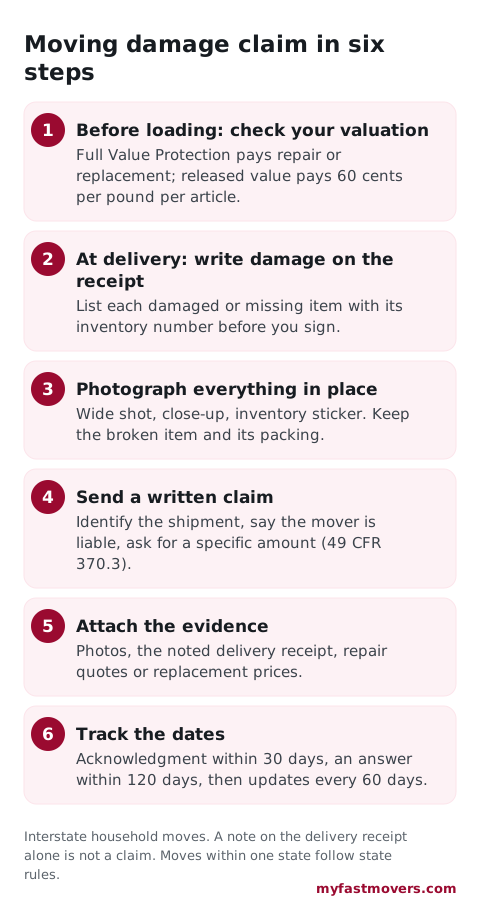
Before the move: the two things that decide your payout
You cannot fix these after the truck leaves, so check them on the bill of lading before you sign.
- Your valuation level. It decides how much the mover owes, more than anything in the claim itself.
- Full Value Protection makes the mover liable for “the replacement value of the household goods”, up to the declared value of the shipment (375.201). The mover may repair the item, replace it with one “of like, kind and quality”, or pay.
- Released value is the cheaper option, and the mover’s liability is “no more than 60 cents per pound, per article”. A 10-pound lamp that arrives in pieces pays 10 × $0.60 = $6.00.
- Items worth more than $100 per pound, such as jewellery, art or electronics, may be limited unless you list them in writing. Moving insurance and valuation explained covers the choice in full.
- Your own record. Photograph furniture and valuables before loading, especially anything already scratched. Keep the inventory the crew writes and check that its condition codes match what you see.
At delivery: write it down before you sign
- Walk through with the crew and open boxes marked fragile.
- Write every damaged or missing item on the delivery receipt or inventory, with the inventory number, before you sign. “Received in good condition” signed under pressure is the sentence movers quote back when they decline claims.
- Photograph damage in place, before you move or repair anything. Take a wide shot, a close-up and the inventory sticker.
- Keep broken items and their packing until the claim is settled. The mover may want to inspect them.
A note on the delivery receipt is evidence, but on its own it is not a claim (370.3).
Step by step: the written claim
- Find the claim address. It is on the bill of lading or the mover’s website. Send the claim to the mover named on the bill of lading; if that is not the company you booked with, send a copy to them too.
- Write the claim. Under 370.3 a claim is “a written communication” that:
- identifies the shipment: bill of lading number, names, dates and addresses;
- asserts that the mover is liable for the loss or damage;
- claims “a specified or determinable amount of money”.
- Price each item. List the item, the inventory number, what is wrong, and the amount. Use a repair quote or the replacement cost of a like item for Full Value Protection, or the weight times $0.60 for released value.
- Attach evidence. Photos, the delivery receipt showing your notes, repair estimates and receipts.
- Send it in a way you can prove. Email with a delivery receipt, the mover’s claim portal with a screenshot of the confirmation, or certified mail. Keep copies of everything.
- Diary the dates. Day 30 for the acknowledgment, day 120 for the answer, then every 60 days.
The clocks, after you file
| Rule | What it says | Source |
|---|---|---|
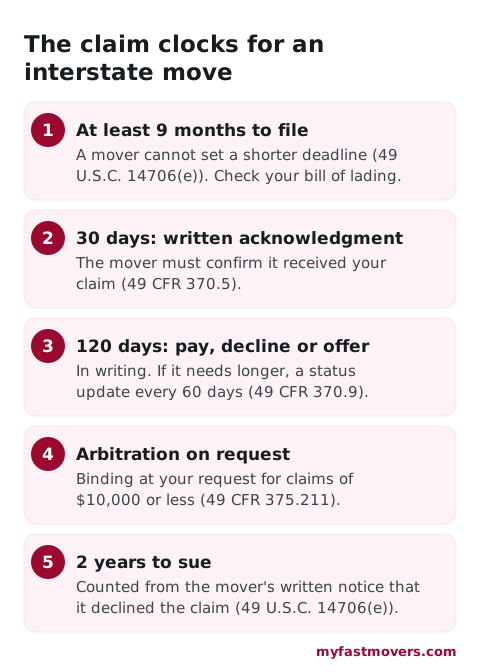
| Time to file | The mover cannot give you less than 9 months | 49 U.S.C. 14706(e) |
| Acknowledgment | In writing, within 30 days of receiving your claim | 49 CFR 370.5 |
| Answer | Pay, decline or make a firm settlement offer in writing within 120 days | 49 CFR 370.9 |
| If it needs longer | A written status update at the end of each further 60 days | 49 CFR 370.9 |
| Time to sue | Not less than 2 years from the mover’s written denial | 49 U.S.C. 14706(e) |
A claim letter you can copy
Subject: Loss and damage claim, bill of lading [number]
To the claims department of [mover’s legal name, USDOT number]:
I am filing a claim for loss and damage to my household goods, shipped under bill of lading [number], picked up at [origin address] on [date] and delivered to [destination address] on [date].
The items below were damaged or missing at delivery. Damage was noted on the delivery receipt on [date], and photos are attached. My shipment was moved under [Full Value Protection with a declared value of $X / released value at 60 cents per pound per article].
Inv. no. Item Damage Amount claimed Basis [12] [Oak dresser] [Leg snapped, top gouged] [$ ] [Repair quote attached] Total claimed: $[amount].
I hold you liable for this loss and damage under 49 U.S.C. 14706 and ask for payment of the amount above. Please acknowledge this claim in writing within 30 days, as 49 CFR 370.5 requires.
[Name, phone, email, current address]
If the answer is no, or too little
- Ask for the reason in writing. A decline must be in writing (370.9), and that written decline starts your 2-year clock to sue.
- Arbitration. Interstate movers must offer it for loss and damage disputes (375.211). For claims of $10,000 or less it is binding if you request it. You cannot be charged more than half the filing cost, and the arbitrator decides within 60 days of receiving the case.
- Small claims or civil court, within the 2-year window.
- An FMCSA complaint at complaint.fmcsa.dot.gov or 1-888-DOT-SAFT puts the mover’s conduct on record. FMCSA says it “does not have the authority to resolve claims against a moving company”, so the complaint goes alongside your claim, not instead of it.
Avoid the next claim
Check the mover before the next move: how to check a mover’s USDOT number shows its registration and inspection record, and how to read a moving estimate shows where the valuation choice sits on the paperwork. Packing fragile items covers the boxes that cause most claims.
Questions people ask
How long do I have to file a moving damage claim?
For interstate moves, federal law does not allow a mover to give you less than 9 months to file a claim, and less than 2 years to sue, counted from the date the mover tells you in writing that it has declined the claim (49 U.S.C. 14706(e)). Your bill of lading states the mover's own deadline; it can be longer, never shorter. File as soon as you can, while the evidence is fresh.
Is writing damage on the delivery receipt enough?
No. Noting damage on the delivery receipt or inventory is important evidence, but 49 CFR 370.3 says such a note alone is not a claim. A claim is a separate written communication that identifies the shipment, says the mover is liable and asks for a specified or determinable amount of money.
How much will the mover pay for a damaged item?
It depends on the valuation you chose on the bill of lading. Under Full Value Protection the mover must repair the item, replace it with one of like kind and quality, or pay its replacement value, up to the declared value of the shipment. Under the cheaper released value option, liability is no more than 60 cents per pound per article, so a 10-pound item that is destroyed pays $6.00.
How long does a mover have to answer my claim?
Under 49 CFR Part 370 the mover must acknowledge your claim in writing within 30 days of receiving it, and must pay, decline or make a firm settlement offer in writing within 120 days. If it cannot decide in 120 days, it must tell you in writing why, and repeat that status update every 60 days until it does.
What if the mover denies my claim or offers too little?
Interstate movers must offer arbitration for loss and damage disputes (49 CFR 375.211). For claims of $10,000 or less, arbitration is binding if you request it; above $10,000 it is binding only if the mover agrees too. You can also sue, within 2 years of the mover's written denial, or file a complaint with FMCSA, although FMCSA does not resolve individual claims.
How this was written. Every cost figure in this article comes from the same published model that powers the calculator, so it cannot disagree with the tool. We do not operate trucks and nobody pays us for placement.
Sources
- 49 CFR 370.3, filing of claims (eCFR) (www.ecfr.gov)
- 49 CFR 370.5, acknowledgment of claims (eCFR) (www.ecfr.gov)
- 49 CFR 370.9, disposition of claims (eCFR) (www.ecfr.gov)
- 49 U.S.C. 14706, liability of carriers under receipts and bills of lading (Cornell LII) (www.law.cornell.edu)
- 49 CFR 375.201, liability for loss and damage (eCFR) (www.ecfr.gov)
- 49 CFR 375.211, arbitration (eCFR) (www.ecfr.gov)
- Appendix A to Part 375, Your Rights and Responsibilities When You Move (eCFR) (www.ecfr.gov)
- FMCSA Protect Your Move, what if I have problems with my move (www.fmcsa.dot.gov)