

How to Get a Moving Quote Without Spam Calls
Why one online moving quote sets off dozens of calls, how to price your move without giving out your number, and what the rules say about making calls stop.
Published October 27, 2026 · 7 min read · By My Fast Movers
In short
Price the move first with a calculator that does not ask for your phone number, then contact two or three movers you have checked yourself, directly, instead of through a form that passes your details to many companies. If calls start anyway, tell each caller to put you on its do-not-call list; under FTC rules it must stop.
To get a moving quote without a flood of calls, price the move yourself first, then contact two or three movers you have checked, directly, instead of through a form that sends your details to many companies. If calls start anyway, tell each caller to put you on its do-not-call list. Under FTC rules it has to stop.
The calls are not an accident. Many “get free quotes” forms are lead sites: your name and number are passed to several movers or brokers, and each one calls to win the job. Nobody called you by mistake; you were sold as a lead.
Why one form brings a dozen calls
A typical quote form asks for your move date, your ZIP codes and your phone number. Somewhere near the submit button there is a line of consent text: you agree to be contacted by “partners” or “service providers”. The site then sends your details to several companies at once.
You end up talking to:
- brokers, who arrange moves but do not run trucks;
- carriers you have never researched;
- sometimes companies that buy leads to resell them.
The more companies that receive the lead, the faster each one has to call you to win it.
Before you press submit on any form, read that consent line. If it says partners, network or third parties, expect calls from more than one company.
Step 1: Get a planning number first, without your phone number
You do not need to talk to anyone to know roughly what your move should cost.
- Our moving cost calculator shows a price range on screen from your ZIP codes, home size and date. Name, email and phone are optional, and we do not sell them.
- For moves under about 100 miles, the local moving cost calculator prices crew hours.
- The packing box calculator tells you how much packing you are pricing.
A planning number is not a quote, but it tells you which quotes are realistic and which are bait.
Step 2: Choose the movers yourself
Instead of letting a form pick for you, make a short list of two or three movers:
- Browse licensed movers near you in our movers by state directory, built from the FMCSA register.
- Check each one: how to check a mover’s USDOT number takes two minutes.
- Know whether it is a carrier or a broker. Brokers must say so on their website (371.107). See moving broker vs carrier.
Step 3: Contact them directly, with the details that matter
Call or email each mover from its own website, not through a comparison site, and give the same information to all three:
- origin and destination;
- home size and any heavy items;
- stairs, elevators and long walks to the truck;
- your dates.
For an interstate move, ask for a survey. Federal rules require the mover to survey your goods, in person or by video, before giving a written estimate, unless you waive it in writing (375.401). A survey is what turns a sales call into a price you can hold them to.
Tips that help:
- Use a separate email for moving enquiries, so the follow-ups do not mix with everything else.
- Say what you want up front: “Please email me a written estimate after a video survey. Do not add me to marketing lists.”
If the calls have already started
The FTC rules are on your side.
- Ask each caller to stop. The FTC says: “if you ask them not to call you, they have to stop.” Calling a consumer who asked not to be called again is a violation of the Telemarketing Sales Rule. Use the words “put my number on your do-not-call list”.
- Know the three-month window. A company you contacted yourself may call you for three months after your inquiry, even if your number is on the National Do Not Call Registry, unless you ask it to stop.
- Register your number at donotcall.gov if you have not already. It stops sales calls from companies you never dealt with.
- Keep a log: company, date, time, number. Report repeat callers at donotcall.gov.
Red flags in the calls themselves
Pressure is a sales tactic, not proof of fraud. Still, slow down if a caller:
- quotes a firm price without seeing your home or a video;
- asks for a large deposit to “hold the date”;
- will not give a USDOT or MC number;
- is a different company from the one whose form you filled in.
FMCSA’s red-flag list includes estimates given “sight unseen” and demands for “a large deposit before the move”. More in moving scams: 9 red flags.
The short version
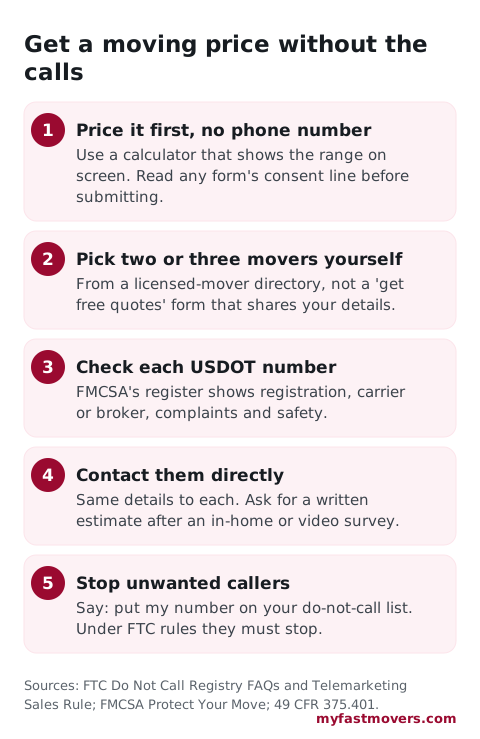
- Get a planning number without giving out your phone number.
- Pick two or three licensed movers yourself and check their USDOT numbers.
- Contact them directly and ask for a written estimate after a survey.
- Tell anyone else who calls to put you on their do-not-call list.
Then use how to read a moving estimate to compare the quotes that come back.
Questions people ask
Why do I get so many calls after asking for a moving quote?
Many quote forms are run by lead sites, not by a mover. Your details are passed to several moving companies or brokers, and each one calls to win the job. The form usually says so in its consent text, often in small print under the submit button. One form can therefore mean calls from many companies you have never heard of.
Does the Do Not Call Registry stop moving company calls?
Not from a company you contacted yourself. Under the FTC's Telemarketing Sales Rule, an inquiry creates an established business relationship that lets that company call you for three months, even if your number is on the National Do Not Call Registry. But if you ask a company not to call you again, it has to stop.
How do I make a moving company stop calling me?
Tell the caller, clearly: 'Put my number on your do-not-call list and do not call me again.' The FTC says that if you ask a company not to call you, it has to stop, and calling a consumer who asked not to be called again is a violation of the Telemarketing Sales Rule. Note the date, time and company name, and report repeat calls at donotcall.gov.
Can I get a moving estimate without giving my phone number?
Yes. A moving cost calculator that shows the result on screen gives you a planning figure without any contact details. On My Fast Movers, name, email and phone are optional and we do not sell them. A binding price still needs a mover's survey of your home, but you choose which movers get your details.
Is a mover that keeps calling me a red flag?
Aggressive calling on its own is not proof of a scam, but it often comes from brokers and lead buyers rather than the carrier that would move you. Before you book any company that called you, check its USDOT number in FMCSA's register and confirm whether it is a carrier or a broker.
How this was written. Every cost figure in this article comes from the same published model that powers the calculator, so it cannot disagree with the tool. We do not operate trucks and nobody pays us for placement.
Sources
- FTC, National Do Not Call Registry FAQs (consumer.ftc.gov) (consumer.ftc.gov)
- FTC, Complying with the Telemarketing Sales Rule (ftc.gov) (www.ftc.gov)
- FMCSA Protect Your Move, search for a mover (www.fmcsa.dot.gov)
- 49 CFR 371.107, broker advertising (eCFR) (www.ecfr.gov)
- 49 CFR 375.401, must I estimate charges? (eCFR) (www.ecfr.gov)