

What Movers Won't Move: Hazmat, Plants, Guns and More
Why movers refuse propane, paint, batteries, plants and food, what federal rules say about guns and high-value items, and how to move each one yourself.
Published November 6, 2026 · 9 min read · By My Fast Movers
In short
Movers refuse hazardous materials such as propane, gasoline, paint, solvents, aerosols, pool chemicals and many large batteries, and most also decline perishable food, plants and pets. Firearms and items worth over $100 a pound can go only if you tell the mover in writing first. Get the mover's written list before packing, then dispose of or carry the rest.
Movers will not load hazardous materials (propane, gasoline, paint, solvents, aerosols, pool chemicals and many large batteries), and most also turn down perishable food, live plants and pets. Firearms and anything worth more than $100 a pound can travel only if you tell the mover in writing first. Get the mover’s written list of refused items before you pack, then sell, give away, dispose of or carry everything on it yourself.
The problem usually shows up late. A crew arrives, finds a gas can or a lithium battery wall unit in the garage, and refuses to load it, or a driver flags a box marked “kitchen” that turns out to hold cleaning sprays. The day slows down and you end up with things you have no way to move. A short list, checked a few weeks ahead, avoids that.
The federal rules quoted here cover interstate moves: household goods carried from one state to another under 49 CFR Part 375, plus federal hazmat, firearms and plant quarantine law. A move that stays inside one state follows that state’s moving rules, though the federal hazmat and firearms rules and a mover’s own policy still decide most of what goes on the truck.
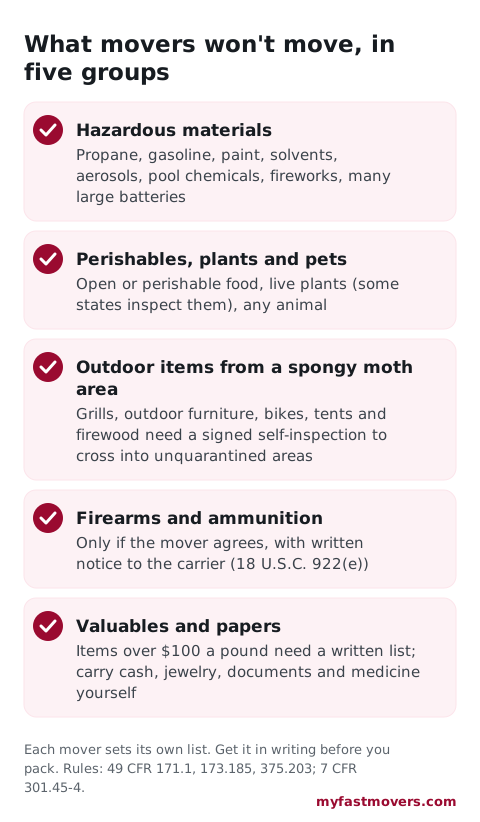
Why the list exists
Three things decide whether an item goes on the truck.
- Federal hazmat law. The Hazardous Materials Regulations, which start at 49 CFR Part 171, govern hazardous materials “in commerce”, including the people who transport them and the people who “cause” them to be transported. A mover hauling your household for pay is transporting in commerce, and a moving van is not packed, marked or placarded for hazmat.
- The mover’s liability. Under 49 CFR 375.203(a), if you include “perishable, dangerous, or hazardous articles” in an interstate shipment without the mover’s knowledge, the mover “need not assume liability” for those articles or for the loss or damage they cause. A leaking can of solvent that ruins a sofa is your loss, not the mover’s.
- The mover’s tariff and policy. Each company publishes what it will and will not carry. Two movers can give different answers on the same item, which is why the written list matters more than any general guide, this one included.
Group 1: hazardous materials
These are refused by essentially every household mover:
| Item | Why | What to do instead |
|---|---|---|
| Propane tanks, camping gas canisters | Flammable gas under pressure | Use them up, exchange them at a tank-exchange cage, or take them to a household hazardous waste site |
| Gasoline, kerosene, lighter fluid | Flammable liquid | Drain mowers, trimmers and generators; give fuel away or use it up |
| Paint, stains, thinners, solvents | Flammable or toxic | Give away sealed cans; take the rest to household hazardous waste |
| Aerosol cans | Pressurized, flammable propellant | Use up or dispose of; buy new at the destination |
| Pool chemicals, pesticides, fertilizer | Reactive or toxic | Household hazardous waste program |
| Fireworks, ammunition | Explosive | Ask about ammunition separately (see firearms below); fireworks stay behind |
| Car batteries, large lithium batteries | Corrosive or fire risk | Ask the mover in writing; see the battery section below |
The EPA describes leftover paints, cleaners, oils, batteries and pesticides as household hazardous waste and points people to local collection programs rather than the trash. Your county or city runs one; how to dispose of furniture, appliances and electronics walks through where each kind goes.
Home backup batteries and power banks
Lithium cells and batteries have their own section of the federal hazmat rules, 49 CFR 173.185. Whether a mover will take a large home backup battery, an e-bike battery or a portable power station is a policy decision, and many movers say no to the large units.
Settle it before you book:
- Send the model and size to each mover and ask, in writing, whether they will carry it and how it must be prepared.
- If the answer is yes, have it written on the estimate, so a crew cannot refuse it on the day.
- If the answer is no, ask the installer or manufacturer about removal and transport. A wall-mounted unit usually needs an electrician to disconnect it anyway.
Small consumer items such as phones and laptops are normally carried with you, not packed, along with their chargers.
Group 2: perishables, plants and pets
Food. Most movers decline perishable and open food on long-distance moves, because a shipment can sit on a truck or in storage for days. Sealed, shelf-stable cans and boxes are a different question; ask. Under 375.203(a) the mover need not take liability for perishables packed without its knowledge, so a spoiled cooler that stains a mattress is on you.
Plants. Most long-distance movers decline live plants, and some states check them at the border. California runs 16 Border Protection Stations on the main highways into the state. The California Department of Food and Agriculture says:
- plants moved by a commercial mover should be listed as “house plants” at the top of the inventory and stored near the van doors so they can be inspected;
- people moving their own plants must declare them and keep them easy to reach;
- inspectors may reject and confiscate plants with pests or disease;
- owners are “strongly discouraged” from bringing citrus, pine and fruit or nut trees unless every quarantine requirement is met.
If you are moving to another state with farm-pest rules, CDFA says the department of agriculture in your current state should be able to explain the destination’s rules and any inspection options.
Pets. A moving van is a cargo space with no climate control or care. Plan to move animals in your own vehicle or with a pet transport service.
Group 3: outdoor items from a spongy moth area
This one surprises people. Under 7 CFR 301.45-4, an “outdoor household article” may not be moved interstate from an area quarantined for the spongy moth (the regulation still uses the old name, gypsy moth) into an area that is not quarantined unless it has a certificate or a signed self-inspection document attached.
The regulation’s definition (7 CFR 301.45-1) lists things kept outside the home, such as:
- barbecue grills, outdoor furniture and toys, bicycles;
- garden tools, dog houses, tents, awnings;
- boats, trailers, recreational vehicles and firewood.
In practice that means checking those items for egg masses and other life stages before loading and filling in the USDA self-inspection checklist the rule refers to. Ask your mover early how it handles the checklist for outdoor items. Firewood is better left behind wherever you live.
Group 4: firearms
Federal law does not ban movers from carrying guns, but many movers choose not to, so ask first. If your mover agrees, 18 U.S.C. 922(e) applies: it is unlawful to knowingly deliver a package containing a firearm or ammunition to a common or contract carrier for interstate shipment “without written notice to the carrier”. The same subsection bars the carrier from requiring a label on the outside of the container that says it holds a firearm.
So, if the mover will take them:
- Give the written notice, and keep a copy.
- Note the make, model and serial number on your own inventory, not on the box.
- Ask separately about ammunition, which many movers refuse as hazardous.
Possession and transport rules also differ from state to state. Check the destination state’s rules, and if you drive them yourself, the rules of every state you pass through.
Group 5: valuables, documents and irreplaceable things
Movers will usually load jewelry, collections and art if you ask, but the paperwork rules make it a poor idea to send small valuables on the truck.
Under 49 CFR 375.203(b) and (c), if you buy protection above the basic 60 cents per pound per article, the mover’s liability for any article worth more than $100 a pound can be limited to $100 a pound unless you told the mover about that article in writing. Tell them in writing and you can recover up to the declared value. Moving insurance and valuation explained covers the two protection levels in full.
Worked example: a ring that weighs a tenth of a pound is far above $100 a pound. If it is not on a written list, the most the mover owes for it under that limit is $100 × 0.1 = $10.
Carry these in your own bag or car:
- cash, jewelry, coins and small collectibles;
- passports, birth certificates, titles, deeds, tax and medical records;
- prescription medicines and a few days of clothes;
- hard drives and anything with family photos you cannot replace;
- keys, chargers and the moving paperwork itself.
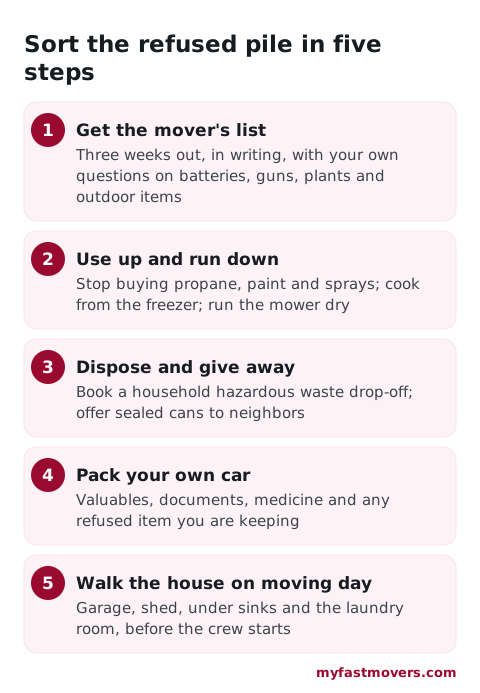
A three-week plan for the refused pile
- Three weeks out: get the list. Ask each mover you are comparing for its written list of refused and restricted items. Put your own questions (battery, guns, plants, outdoor items) in the same email.
- Use up and run down. Stop buying propane, paint and cleaning sprays. Cook from the freezer. Run the mower dry.
- Two weeks out: dispose and give away. Book a household hazardous waste drop-off. Offer sealed paint, fuel and garden chemicals to neighbors. Decluttering before a move shows what each item you drop saves on the bill.
- One week out: pack your own car. Set aside the valuables, documents, medicines and anything the mover refused that you are keeping.
- Moving day: walk the house. Check the garage, shed, under sinks and the laundry room before the crew starts, since those are where refused items hide.
If the refused pile is large, or you are moving only a few things anyway, moving a few items long distance compares freight, containers and shipping services, and a figure from the moving cost calculator shows what the rest of the move should cost before you take quotes.
What to put in writing with your mover
Before booking, get these answers in writing and keep them with your estimate:
- the mover’s list of refused and restricted items;
- a yes or no on each specific item you asked about;
- any item it agreed to carry with conditions, written on the estimate;
- your written notice for firearms, and your written list of articles worth more than $100 a pound.
That way, a crew on moving day is working from the same list you are. How to read a moving estimate shows where special items and conditions belong on the paperwork.
Questions people ask
Why won't movers take propane tanks, paint or gasoline?
They are hazardous materials. Federal Hazardous Materials Regulations, which start at 49 CFR Part 171, govern how hazardous materials move in commerce, and a household moving van is not set up to meet them. Under 49 CFR 375.203 an interstate mover also need not accept liability for hazardous articles packed without its knowledge, or for the damage they cause to the rest of the load.
Will movers move a home backup battery or a lithium power bank?
Ask before you book, in writing. Lithium cells and batteries have their own section of the federal hazmat rules (49 CFR 173.185), and each mover sets its own policy. Many refuse large lithium units outright. If yours says no, ask the installer or manufacturer about removal and transport, and get any yes in writing on the estimate.
Can movers move my guns?
Some will and some will not; it is the mover's policy. If yours agrees, federal law (18 U.S.C. 922(e)) requires you to give the carrier written notice that a firearm or ammunition is in the shipment, and bars the carrier from requiring an outside label that says so. Ammunition is a separate question, since many movers refuse it as hazardous. Check the destination state's possession rules too.
Can I pack my plants on the moving truck?
Most long-distance movers decline live plants, and some states inspect them at the border. California's Department of Food and Agriculture says plants carried by a moving company should be listed as 'house plants' at the top of the inventory and stored near the van doors for inspection, and inspectors may confiscate plants that show pests or disease.
What should I do with jewelry, cash and important papers?
Carry them yourself. Under 49 CFR 375.203, if you buy higher protection but do not tell the mover in writing about an article worth more than $100 a pound, the mover's liability for it can be limited to $100 a pound. Small, high-value items are also the easiest to lose, so keep them, medicines and documents in your own car or bag.
How this was written. Every cost figure in this article comes from the same published model that powers the calculator, so it cannot disagree with the tool. We do not operate trucks and nobody pays us for placement.
Sources
- 49 CFR 375.203, actions of a shipper that may limit the mover's liability (eCFR) (www.ecfr.gov)
- 49 CFR 171.1, applicability of the Hazardous Materials Regulations (eCFR) (www.ecfr.gov)
- 49 CFR 173.185, lithium cells and batteries (eCFR) (www.ecfr.gov)
- 18 U.S.C. 922(e), firearms delivered to a common or contract carrier (Cornell LII) (www.law.cornell.edu)
- 7 CFR 301.45-1, definitions including outdoor household articles (eCFR) (www.ecfr.gov)
- 7 CFR 301.45-4, interstate movement of outdoor household articles from quarantined areas (eCFR) (www.ecfr.gov)
- CDFA: transport of privately owned house plants into California (www.cdfa.ca.gov)
- CDFA: California Border Protection Stations (www.cdfa.ca.gov)
- EPA: Household Hazardous Waste (HHW) (www.epa.gov)