

Moving a Few Items Long Distance: 5 Ways Compared
Only a few pieces of furniture and some boxes to move across the country? Five ways to do it, what each costs in our model, and the rules on small shipments.
Published October 30, 2026 · 8 min read · By My Fast Movers
In short
For a few items going a long way, compare five options: drive them yourself, a portable container, a shared freight trailer you load, a licensed mover on a small load, or parcel shipping for boxes only. A small load does not get a proportionally small price, because minimum charges apply, so get each minimum in writing.
To move a few items a long distance, you have five realistic options: drive them yourself, book a portable container, load a section of a shared freight trailer, hire a licensed mover for a small load, or ship boxes as parcels. The catch is that a small load does not get a small price in proportion: interstate movers can charge a minimum weight or volume, and that minimum has to be written on your bill of lading. Get it in writing before you compare.
It is one of the most common questions from people moving right now: a single person with a mattress, a desk and some boxes, a parent’s antique cabinet and a lamp after a death in the family, or a couple who want to keep a few pieces of vintage furniture but cannot pay for a full cross-country move. Full-service quotes are built for whole homes, so a handful of items can feel overpriced and hard to place.
This guide compares the five ways, puts our cost model’s numbers next to each, and lists the federal rules that matter most for small shipments. Those rules (49 CFR Part 375) cover interstate household goods moves only. A move that starts and ends in the same state follows that state’s rules.
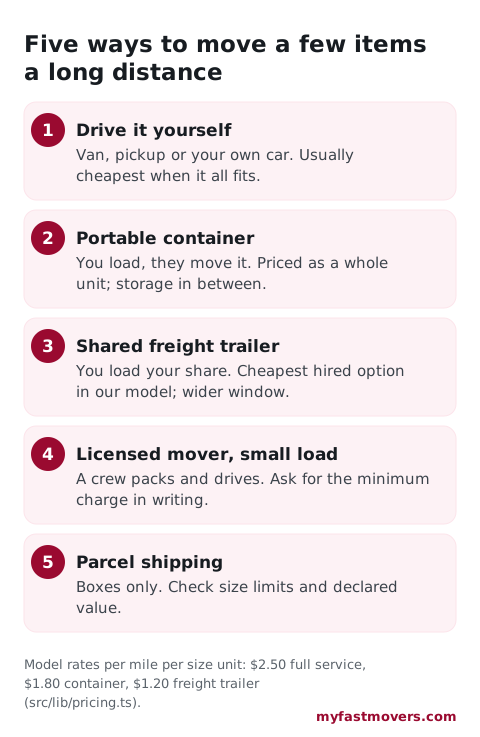
The five ways, side by side
| Option | Who loads and drives | Best for | Watch out for |
|---|---|---|---|
| Drive it yourself | You load, you drive | A van-load or less, when you have a few days and help at both ends | Fuel, lodging and the return trip; lifting heavy pieces alone |
| Portable container | You load, a company moves the container | A few rooms’ worth, or when you need storage in between | You pay for the whole container, not the space you use |
| Shared freight trailer | You load your section, the company drives | Price-sensitive moves with a flexible delivery date | Longer delivery windows; you still do all the lifting |
| Licensed mover, small load | The mover packs, loads and drives | Heavy or fragile pieces you cannot lift or wrap | Minimum charges; a delivery spread of several days |
| Parcel shipping | You pack, a parcel carrier delivers | Boxes of clothes, books and keepsakes only | Size and weight limits; the carrier’s own liability terms |
The first four can be mixed with the last. A common split: furniture goes by container or trailer, while boxes of personal papers and small valuables travel with you or by parcel.
What our cost model says
Our moving cost calculator prices whole homes, so its smallest load is a studio apartment. A few items is less than a studio, but minimum charges mean the price rarely falls in proportion, so the studio figure is a useful reference for what the three hired options cost relative to each other.
Studio-size load, from our model (src/lib/pricing.ts, updated 2026-09-23):
| Distance | Full-service movers | Portable container | Shared freight trailer |
|---|---|---|---|
| 500 miles | $1,688–$2,250 | $1,215–$1,620 | $810–$1,080 |
| 1,000 miles | $3,375–$4,500 | $2,430–$3,240 | $1,620–$2,160 |
| 2,000 miles | $6,750–$9,000 | $4,860–$6,480 | $3,240–$4,320 |
How those are built: distance × a size factor (1.5 for a studio) × a rate per service ($2.50 for full service, $1.80 for a container, $1.20 for a freight trailer), with the range running from 90% to 120% of that figure. For 1,000 miles by freight trailer: 1,000 × 1.5 × $1.20 = $1,800, so $1,620 to $2,160. The model also sets a floor for any long-distance job: $500 full service, $350 container and $250 freight.
Two things follow. First, the freight trailer costs less than half of full service for the same load in the model ($1.20 against $2.50 per unit), so doing your own loading is where most of the saving comes from. Second, these are planning figures, not quotes. A real quote for three pieces of furniture can come in under the studio figure or near it, depending on the company’s minimum.
Driving yourself is not in the model, because the cost depends on the vehicle, fuel and how many nights you spend on the road. Moving truck rental cost breaks down how a rental price is built, including one-way fees and mileage.
Option by option
1. Drive it yourself
If everything fits in a cargo van, a pickup or your own car, this is usually the cheapest way and the fastest: your things arrive when you do. Add up the rental, fuel, nights on the road and the flight or drive back if the rental is not one-way. Pad and strap every piece, and keep heavy items low and against the front wall. If you are alone, book two hours of local loading help at each end rather than lifting a dresser by yourself.
2. Portable container
A container company drops a box at your door, you load it, and it is moved to your new address or held in storage. It suits a few rooms better than a few items, because the smallest container is still priced as a whole unit. It wins when you need time between move-out and move-in. Moving containers vs full-service movers compares the two in detail.
3. Shared freight trailer
You load your items into your share of a trailer, and the trailer carries other people’s shipments too. It is the cheapest hired option in our model. The trade-off is time: a shared trailer routes around other customers’ stops, so ask for the delivery window in writing and expect it to be wider than a dedicated truck’s.
4. A licensed mover on a small load
When the pieces are heavy, awkward or fragile, paying a crew is often the only sensible route. Some long-distance movers combine small shipments on one truck. Expect a delivery spread: the federal booklet explains that the shipment “could arrive anytime during the delivery spread”, and that the mover must give you 24 hours’ notice before arriving (Appendix A). The mover must deliver on the agreed date or within the period on the bill of lading (375.603).
5. Parcel shipping
For boxes of clothes, books, photos and documents, a parcel carrier can be the simplest choice. Each carrier publishes its own size and weight limits and its own liability terms, so check both before packing furniture-sized items, and pay for declared value on anything that matters.
Federal rules that matter most for a small shipment
If you hire a company to carry your household goods across state lines, these parts of 49 CFR Part 375 apply. Furniture and personal effects from your home, shipped on a move you arrange and pay for, count as household goods under the federal definition (375.103).
- Minimum charges must be written down. A mover that prices on a minimum weight or volume must show “the minimum weight- or volume-based rates, and the minimum charges applicable to the shipment” on the bill of lading (375.505). Ask for that line before you book, not on loading day.
- A survey comes first. The mover must survey your goods, on-site or by video, before giving a written estimate, unless you waive it in writing before loading (375.401). For a few items, a short video call is enough.
- Small shipments are weighed differently. A shipment of 3,000 pounds or less may be weighed on a certified platform or warehouse scale, before loading or after unloading (375.511). You have the right to watch every weighing (375.513) and to ask for a reweigh before delivery (375.517).
- The most you pay at delivery is capped. On a non-binding estimate, the mover must release your goods once you pay 110 percent of the estimate, plus services you added later (375.703). On a binding estimate, the cap is the estimate itself.
- Check the registration. Interstate movers must be registered with FMCSA and have a USDOT number. How to check a mover’s USDOT number shows how in two minutes, and the FMCSA mover search shows whether a company is a carrier or a broker.
Protecting a few valuable items
When you move only a few things, they are often the ones that matter most, and the default protection is thin.
- Released value is free and pays no more than 60 cents per pound per article (375.203). Worked example: a 60-pound antique cabinet lost in transit would be covered for 60 × $0.60 = $36, whatever it is worth.
- Full Value Protection makes the mover repair, replace or pay for lost or damaged items, up to the declared value. The federal booklet sets the minimum valuation at $6.00 per pound times the shipment weight (Appendix A). Worked example: a 400-pound shipment has a minimum declared value of 400 × $6.00 = $2,400.
- Items worth more than $100 per pound need to be listed in writing. If you do not list them, the mover may limit its liability for each such article to $100 per pound (375.203). Worked example: a 20-pound lamp worth $3,000 is $150 per pound; unlisted, the cover could stop at 20 × $100 = $2,000.
Moving insurance vs valuation explains the two levels in full. For the smallest and most precious items, such as jewelry, documents and photo albums, the safest carrier is you.
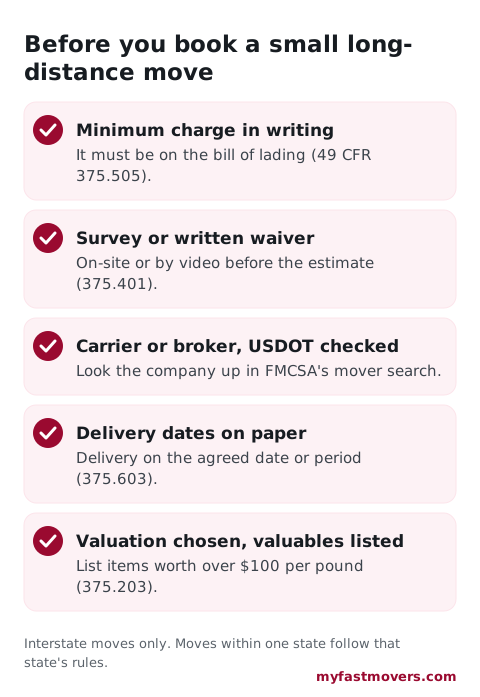
Step by step: booking a small long-distance move
- Make a short list of every item, with rough sizes. Photograph each piece, front and back.
- Price the do-it-yourself route first: van or truck rental, fuel, nights on the road and the return trip.
- Run the calculator for a studio-size load at your distance to see how full service, a container and a freight trailer compare.
- Ask each company the same three questions in writing: what is your minimum charge, what delivery window do you give, and are you the carrier or a broker?
- Check the USDOT number of whoever will actually carry your goods.
- Choose the protection level before loading, and list anything worth more than $100 per pound.
- On loading day, read the bill of lading for the minimum charge, the delivery dates and the maximum due at delivery before you sign.
Moves of a few items within one state follow the same practical steps, but the pricing and consumer rules come from that state rather than from Part 375.
Questions people ask
What is the cheapest way to move a few items across the country?
Usually driving them yourself in a rented van or your own car, if you have the time and can lift the pieces. After that, in our cost model, a shared freight trailer you load yourself costs about half of what full-service movers cost for the same load and distance, and a portable container sits in between. Parcel shipping only makes sense for boxes.
Do movers charge a minimum for small long-distance moves?
Many do. Federal rules let an interstate mover price on a minimum weight or volume, but the bill of lading must show the minimum rates and minimum charges that apply to your shipment (49 CFR 375.505). Ask for the minimum in writing before booking, because for a handful of items it often sets the price.
How is a small shipment weighed?
An interstate mover may weigh a shipment of 3,000 pounds or less on a certified platform or warehouse scale, before loading or after unloading, instead of weighing the whole truck (49 CFR 375.511). You have the right to watch every weighing and to ask for a reweigh before delivery.
How do I protect a few valuable items, such as antiques, on a long-distance move?
Choose Full Value Protection rather than the free released value of 60 cents per pound per article, and list in writing any item worth more than $100 per pound. If you do not list it, the mover may limit its liability for that article to $100 per pound (49 CFR 375.203). Hand-carry the smallest, most valuable pieces if you can.
Do these federal rules apply if I move within one state?
No. The rules in 49 CFR Part 375 cover interstate household goods moves. A move that starts and ends in the same state follows that state's rules, set by its transportation, public utility or consumer protection agency, and they differ from state to state.
How this was written. Every cost figure in this article comes from the same published model that powers the calculator, so it cannot disagree with the tool. We do not operate trucks and nobody pays us for placement.
Sources
- 49 CFR 375.103, definitions incl. household goods (eCFR) (www.ecfr.gov)
- 49 CFR 375.203, released value and articles over $100 per pound (eCFR) (www.ecfr.gov)
- 49 CFR 375.401, surveys and written estimates (eCFR) (www.ecfr.gov)
- 49 CFR 375.505, contents of the bill of lading (eCFR) (www.ecfr.gov)
- 49 CFR 375.511, weighing shipments of 3,000 pounds or less (eCFR) (www.ecfr.gov)
- 49 CFR 375.513, observing weighings (eCFR) (www.ecfr.gov)
- 49 CFR 375.517, the reweigh (eCFR) (www.ecfr.gov)
- 49 CFR 375.603, delivery on the agreed date or period (eCFR) (www.ecfr.gov)
- 49 CFR 375.703, maximum collect-on-delivery amount (eCFR) (www.ecfr.gov)
- Appendix A to Part 375, Your Rights and Responsibilities When You Move (eCFR) (www.ecfr.gov)
- FMCSA, Search for a Registered Mover (www.fmcsa.dot.gov)