

Moving Pets to Another State: Papers, Rules and Transport
How to move a dog or cat to another state: the destination state's entry rules, the vet papers to get, and whether to drive, fly or hire a pet shipper.
Published November 10, 2026 · 8 min read · By My Fast Movers
In short
Your moving company will almost never carry a pet, so plan the animal's trip separately. Check the destination state's entry rules with its agriculture department, get rabies proof and any health certificate from your vet, then drive the pet yourself, fly it, or hire a pet transporter registered with USDA. Hawaii is the strict exception.
Your moving company will almost never carry your pet, so the animal needs its own plan. Check the destination state’s entry rules with its department of agriculture, get rabies proof and any health certificate your vet must sign, then choose how the pet travels: in your car, on a flight, or with a pet transport company registered with USDA. Hawaii is the strict exception, with a quarantine law that takes months of preparation.
The question comes up in nearly every long-distance move with an animal, and the hard cases are the ones where the owner cannot drive: a big dog that will not fit in a cabin carrier, one person moving two cars, or a dog that has to go ahead of or behind its owner. This guide walks through the rules that apply and the three ways to get the animal there.
Why the moving truck is not an option
A moving van is a closed cargo space. It has no climate control, no one opens it between pickup and delivery, and a long-distance shipment can sit in a warehouse or ride with other households’ goods for days. Movers list pets with perishables and plants among the things they will not load, as covered in what movers won’t move.
So the pet’s trip is separate from the household goods. It also runs on a different clock: on a long-distance move your furniture arrives inside a delivery window that can stretch over days (see how long a long-distance move takes), while you and the pet usually arrive first. Plan where the animal sleeps and eats in an empty or half-furnished home.
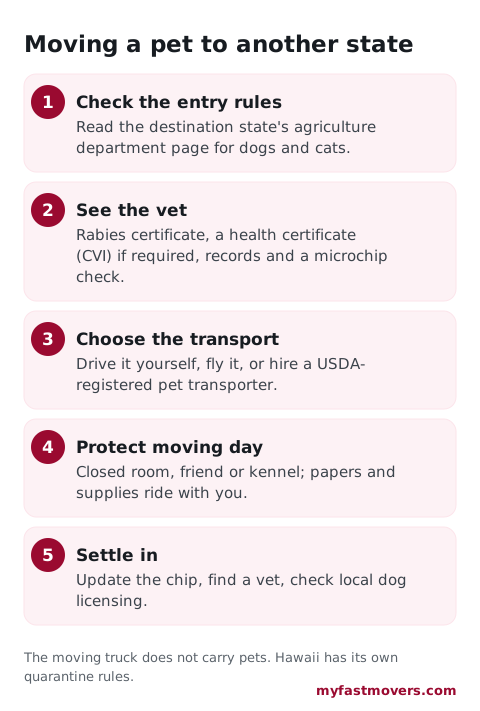
Step 1: Look up the destination state’s entry rules
There is no single national rulebook for a pet crossing a state line. Each state sets its own entry rules for dogs and cats, usually through its department of agriculture or state veterinarian. The rules differ more than most people expect. Two examples, both from the state agencies’ own pages:
| State | Dogs | Cats | Notes |
|---|---|---|---|
| California | Proof of current rabies vaccination if 4 months or older. A health certificate (CVI) is required when the dog is imported for sale, adoption or any other change of ownership. | No CVI and no rabies vaccination required. | Ferrets are a restricted species and are not allowed in. |
| Hawaii | Rabies quarantine law. Dogs meeting every requirement of the 5 Day Or Less program can be released at the Honolulu airport; others can be quarantined for up to 120 days. | Same as dogs. | A higher airport release fee applies when documents reach the quarantine station less than 10 days before arrival. |
California’s page also notes that airlines may set their own requirements, including a health certificate, and suggests contacting the airline 3 to 4 weeks before the flight. That is a useful general rule: the state’s rules and the airline’s rules are separate, and you must meet both.
For any other state, search for the state’s department of agriculture plus “dog import” or “animal entry requirements”, and read the page for household pets (not livestock). Write down three things: whether a CVI is needed, the rabies vaccination rule, and how recently the vet must have examined the animal.
These are state rules for moves within the United States. Taking a pet abroad is a separate process run by the destination country; see the moving abroad checklist.
Step 2: Book the vet visit and collect the papers
Book the visit as soon as you know your route and travel date, and tell the vet which state you are moving to and how the pet will travel. Ask for:
- The rabies vaccination certificate, signed, with the vaccine and its date. Carry the original or a clear copy, not just the tag.
- A Certificate of Veterinary Inspection (CVI), also called a health certificate, if the destination state or the airline requires one. A CVI is issued after an exam, so its date matters; ask the vet how long it stays valid for your trip.
- Medical records and any prescriptions, enough to cover the first weeks before you find a new vet.
- A microchip check, and an update of the chip registry with your new address and phone number.
Keep these papers in the car or your carry-on, never in a box on the moving truck. If the pet is flying or traveling with a transporter, put copies in an envelope taped to the crate as well.
Step 3: Choose how the pet travels
Driving it yourself
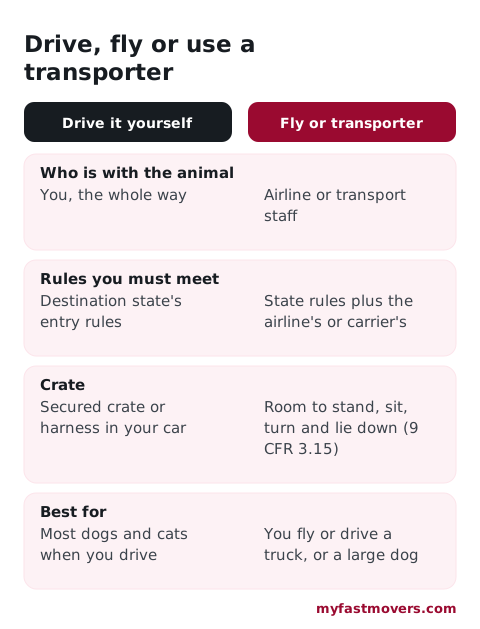
For most dogs and cats this is the simplest option. The animal stays with you, there are no airline crate rules, and you control the stops. Plan the drive around the animal: a secured crate or harness, water and food from home, and pet-friendly lodging booked ahead for each night. Never leave the animal alone in a parked car.
If you are driving a rental truck and towing a car, check the truck rental’s rules on passengers and animals in the cab before you book; the trade-offs of driving, towing or shipping a car are in tow your car or ship it.
Flying it
Small pets may fly in the cabin under the airline’s own pet policy; larger animals fly as checked baggage or cargo where the airline allows it. Each airline sets its own size, breed, route and temperature limits, so read its pet page and call before you buy your own ticket.
When an airline or other carrier takes a dog or cat as cargo, federal Animal Welfare Act rules apply to how it is accepted and crated:
- Drop-off timing. The carrier must not accept the animal more than 4 hours before the scheduled departure, extendable by up to 2 hours by agreement (9 CFR 3.14).
- Food and water statement. You must certify in writing that the animal was offered food and water in the 4 hours before drop-off, with feeding instructions for the next 24 hours, attached to the outside of the crate (9 CFR 3.14).
- Crate size. The crate must let the animal turn around normally while standing, stand and sit erect, and lie in a natural position (9 CFR 3.15).
- One animal per crate. By air, no more than one dog or cat 6 months of age or older may travel in the same crate (9 CFR 3.15).
Emotional support animals. The Department of Transportation’s air travel rule defines a service animal as a dog individually trained to do work or perform tasks for a person with a disability. Emotional support, comfort and companionship animals are not service animals under that rule (14 CFR 382.3), so airlines can treat them as pets, with pet fees and crate rules.
Hiring a pet transport company
A pet transporter drives the animal for you, which helps when you are flying, driving a truck, or moving a large dog that cannot fly in the cabin. A business that transports animals for hire is a “carrier” under the Animal Welfare Act regulations (9 CFR 1.1), and carriers must register with USDA and renew that registration every 3 years (9 CFR 2.25).
Before you pay, get in writing:
- The company’s USDA registration and the legal name you are paying.
- Pickup and delivery dates or windows, and whether the animal rides alone or with other animals.
- Who drives, how often the animal is let out, fed and watered, and where it stays overnight.
- How you get updates, and what happens if the vehicle breaks down.
- The total price, the deposit, and the cancellation and refund terms.
These checks mirror the ones for a household mover: a real registration, one legal name, and every promise in writing. The same habits that help you check a mover’s USDOT number apply here.
Step 4: Plan moving day around the animal
Moving day is the riskiest day for a pet. Doors stay open for hours, the crew is carrying heavy furniture, and the animal is stressed. Keep it in one closed room with a sign on the door, at a friend’s home, or at a boarding kennel for the day.
Pack a separate bag that rides with you: food, bowls, leash, litter and litter box, bedding, medication, waste bags, a recent photo, and the papers from Step 2. At the new home, set up one quiet room with familiar bedding before letting the animal explore, and check fences, gates and window screens on the first day.
Step 5: Do the paperwork at the new address
After the move, update the microchip registry if you have not, find a new vet, and check the local licensing rules for dogs in your new city or county; the new county’s animal services office is the authority. Add these to your moving out of state checklist so they are not lost among the address changes.
Moves to Hawaii
Hawaii stands apart from other states: a pet move there needs months of lead time. Its rabies quarantine law covers every dog and cat, puppies and kittens included. Animals that meet all pre-arrival and post-arrival requirements of the 5 Day Or Less program may qualify for direct release at the Honolulu airport after inspection; animals that do not can be quarantined for up to 120 days.
From the Hawaii Department of Agriculture’s page:
| Item | What the state lists |
|---|---|
| Wait after a successful FAVN rabies antibody test | 30 days minimum before arrival |
| Wait after the most recent rabies vaccination | 30 days minimum before arrival |
| Direct airport release in Honolulu | $185, or $244 if documents arrive less than 10 days before arrival |
| 5 Day Or Less program | $244 |
The page notes that puppies and kittens will usually be about 6 months old by the time the preparations are complete. Start with the state’s checklist as soon as a Hawaii move is likely.
What it costs
We do not publish a price for pet transport, because it depends on the animal’s size, the route, the airline or transporter, and the season. Build the total from real quotes: the vet visit and certificate, an airline-approved crate if flying, the airline’s pet or cargo fee or the transporter’s quote, and lodging on the drive. Then add it to the household move itself, which you can estimate with the free moving cost calculator.
Questions people ask
Do I need a health certificate to move my dog to another state?
It depends on the state you are moving to, because each state sets its own entry rules. California, for example, asks for proof of current rabies vaccination for dogs 4 months or older and requires a health certificate (CVI) only when the dog is changing ownership. Other states can ask for a CVI for every dog. Check the destination state's agriculture department and, if you fly, the airline.
Can the moving company take my dog or cat in the truck?
Plan on no. A moving van is a closed cargo space with no climate control and no one checking on the animal, and moving companies list pets among the things they will not load. Carry pets in your own vehicle, fly them, or book a separate pet transport company.
Is my emotional support animal treated as a service animal on a flight?
No. Under the US Department of Transportation's air travel rule, a service animal is a dog individually trained to do work or perform tasks for a person with a disability. Emotional support, comfort and companionship animals are not service animals under that rule, so airlines can treat them as pets under their own pet policies and fees.
How do I check a pet transport company?
A business that transports animals for hire is a carrier under the Animal Welfare Act regulations (9 CFR 1.1), and carriers must register with USDA and renew that registration every 3 years (9 CFR 2.25). Ask for the registration, get the pickup and delivery plan in writing, and confirm who is driving and how often the animal is checked.
What is different about moving a pet to Hawaii?
Hawaii has a rabies quarantine law. Dogs and cats that meet every requirement of its 5 Day Or Less program can be released at the Honolulu airport after inspection; those that do not can be quarantined for up to 120 days. The preparation takes months, so start with the Hawaii Department of Agriculture's checklist as soon as the move is likely.
How this was written. Every cost figure in this article comes from the same published model that powers the calculator, so it cannot disagree with the tool. We do not operate trucks and nobody pays us for placement.
Sources
- Hawaii Department of Agriculture, Animal Quarantine Information Page (hdoa.hawaii.gov)
- California Department of Food and Agriculture, Animal Importation FAQ (www.cdfa.ca.gov)
- 14 CFR 382.3, definitions including service animal (eCFR) (www.ecfr.gov)
- 9 CFR 1.1, Animal Welfare Act definitions including carrier (eCFR) (www.ecfr.gov)
- 9 CFR 2.25, registration of carriers and intermediate handlers (eCFR) (www.ecfr.gov)
- 9 CFR 3.14, consignments of dogs and cats to carriers (eCFR) (www.ecfr.gov)
- 9 CFR 3.15, primary enclosures used to transport dogs and cats (eCFR) (www.ecfr.gov)