

Tow Your Car or Ship It? Moving Long Distance With a Car
Drive it, tow it behind the rental truck or ship it: which cars fit a tow dolly, the weight limits, what tow coverage excludes and the fuel math.
Published November 10, 2026 · 8 min read · By My Fast Movers
In short
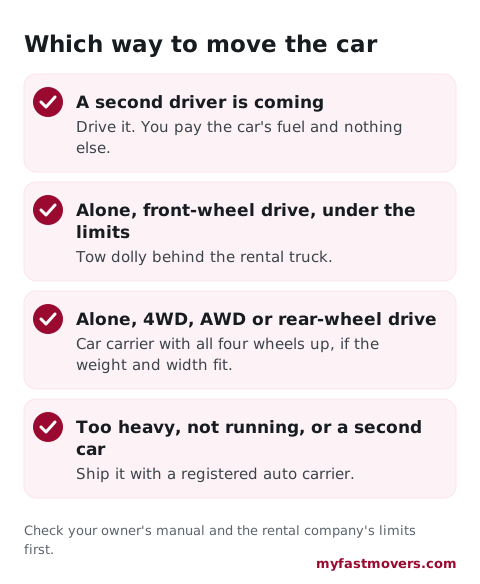
With a second driver, driving the car costs only fuel. Alone, tow it behind the rental truck if it fits the equipment: a tow dolly suits front-wheel-drive cars, a car carrier suits four-wheel and all-wheel drive, and both have weight and width limits. Ship the car when it does not fit, does not run, or is a second car.
If someone can drive the car, drive it: the only cost is fuel. If you are moving alone in a rental truck, tow the car when it fits the towing equipment, and ship it when it does not fit, does not run, or is the second car. The rest of this guide is how to tell which case you are in, using the rental companies’ own limits and arithmetic you can redo with your own numbers.
It is written for a do-it-yourself move in a rental truck. If you are hiring a full-service mover, ask whether it can carry the car or arrange a car carrier, and get that in the written estimate.
The three ways to get a car there
| Drive it | Tow it behind the truck | Ship it | |
|---|---|---|---|
| Who it suits | Two or more drivers | One driver, one car that fits the equipment | A car that does not fit or run, a second car, or no truck |
| What you pay | Fuel for the car | Equipment rental, optional tow coverage, extra truck fuel, higher tolls | The carrier’s rate |
| What it adds | A second vehicle on the road for the whole trip | A longer, slower rig that should not be reversed | A pickup window and a delivery window to plan around |
| Miles on the car | All of them | Rear-wheel miles on a dolly, none on a carrier | None |
Option 1: drive it
A car driven behind the truck costs fuel and nothing else on the invoice. The formula is the same one used for the truck:
miles ÷ miles per gallon × price per gallon = fuel cost
The U.S. Energy Information Administration lists regular gasoline at a national average of $4.153 per gallon for the week of November 2, 2026. Worked example, with round numbers:
| Trip | Car at 25 mpg | Car at 35 mpg |
|---|---|---|
| 1,000 miles | 40 gal, $166 | 28.6 gal, $119 |
| 2,000 miles | 80 gal, $332 | 57.1 gal, $237 |
Use your own car’s highway figure and the current price. The real costs of this option are not dollars: two tired drivers instead of one, no one to swap with in the truck, and the car’s share of the trip’s wear. A loaded truck sets the pace either way; driving a moving truck across the country covers how many miles a day is realistic.
Option 2: tow it behind the rental truck
Rental companies offer two pieces of towing equipment, and they are not interchangeable.
- A tow dolly lifts the front wheels; the rear wheels roll on the road.
- A car carrier (also called an auto transport) is a full trailer; all four wheels ride on it.
Which one your car needs
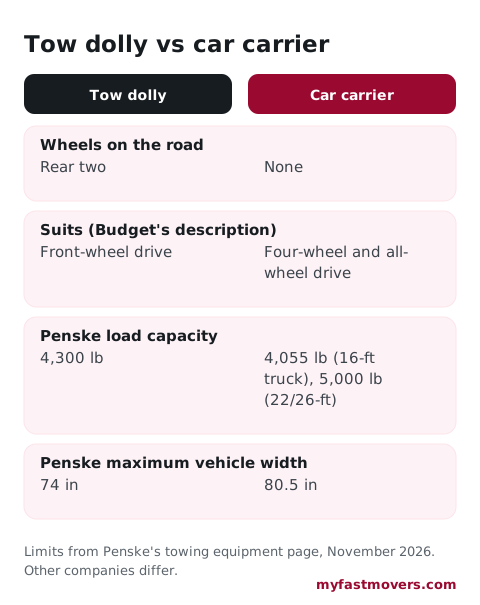
Start with the drive wheels. Budget describes its tow dolly as the “best option for front wheel-drive vehicles” and its car carrier as “recommended for four wheel-drive and all-wheel drive vehicles.” Penske’s tow dolly instructions are stricter still:
- the vehicle must have lockable steering;
- a dolly “cannot be used to tow mid- or rear-engine mounted vehicles”;
- rear-wheel, four-wheel or all-wheel-drive vehicles “must have their drive shaft disconnected and removed.”
Nobody wants to pull a drive shaft in a parking lot, so in practice: front-wheel drive can go on a dolly; everything else goes on a carrier. Your owner’s manual has the manufacturer’s towing instructions for your exact model, and it outranks any general rule.
The weight and width limits
Penske publishes its limits. Other companies’ figures differ, so use these as an example of what to check, not as universal numbers.
| Penske limit | Tow dolly | Car carrier |
|---|---|---|
| Load capacity | 4,300 lb | 4,055 lb behind a 16-ft truck; 5,000 lb behind a 22-ft or 26-ft truck |
| Maximum vehicle width | 74 in | 80.5 in |
| Maximum wheelbase | 125 in | 128 in |
Worked example. A sedan with a 3,400 lb curb weight is under every limit in the table. An SUV at 4,600 lb is over the dolly’s 4,300 lb and over the carrier’s 4,055 lb behind a 16-foot truck; it fits the carrier only behind a 22-foot or 26-foot truck. So the car can decide the truck size, not only the other way round. If you were planning on a smaller truck, check what size moving truck you need with the towing limit in mind.
Penske also warns that vehicles “with a low front end or air dams may not have enough ground clearance” for the ramps. Find your curb weight, width and wheelbase in the owner’s manual before you reserve.
What towing adds to the bill
- The equipment. A dolly or carrier is rented separately from the truck, and the price depends on route and date like the truck’s own. It will be a line on the same reservation; how a moving truck rental is priced lists the other lines.
- Truck fuel. A truck pulling a car burns more fuel. No rental company publishes a towing figure, so here is an illustration only: Budget states 8 – 10 mpg for its 26-foot diesel truck. If towing moves you from the top of that range to the bottom over 1,000 miles, that is 125 gallons instead of 100. At the EIA diesel average of $6.292 for the week of November 2, 2026, the extra 25 gallons cost $157.
- Tolls. Many toll roads charge by axle count, and a dolly or carrier adds axles.
- Time. Some states set a lower speed limit for any vehicle towing another. California’s Vehicle Code section 22406 caps a truck “drawing any other vehicle” at 55 miles per hour. Check the states on your route.
What towing does not cover
This is the part people find out afterwards.
- Damage to your car is yours by default. Penske states that it “is not responsible for any damage to a towed vehicle” and tells renters to consult their insurance carrier. Budget’s terms say the renter is “responsible for all loss of and damage to any towed or transported vehicle.”
- Optional coverage has limits. Budget sells Auto Tow Protection. Its summary covers the towed car for collision, overturn, fire, flood and wind, “on an actual cash value basis up to $20,000” with “a $500 deductible per loss.” It excludes theft and “losses occurring during loading and unloading,” which is exactly when a bumper meets a ramp.
- Nothing rides in the car. Budget’s terms say the towed vehicle “must not contain passengers or cargo.” Penske says not to load “possessions, people or pets” in it. The car is not extra cargo space.
- You cannot back up. Penske says to avoid reversing with a towing device attached because “severe damage to your vehicle and the tow device could result.” Plan fuel stops, hotels and the driveway at the far end so you can always pull through.
Before you reserve, call your own auto insurer and ask one question in writing: is my car covered while it is being towed on rented equipment behind a rental truck?
Option 3: ship it
Shipping means an auto carrier collects the car and delivers it on its own schedule. It is the answer when:
- the car is over the weight or width limits, or too low for the ramps;
- it does not run;
- you have two cars and one driver, since a truck tows one;
- you are not driving a truck at all, for example with a moving container.
This site does not publish a car-shipping price model, so there is no dollar figure here. A quote is a bid for a slot on a truck already running your route; how car shipping is priced explains the seven things that move it and why the first number often rises.
Three checks matter more than the price:
- Registration. A company hauling cars for hire across state lines needs FMCSA motor carrier registration, and a broker needs its own broker registration (49 CFR 365.101). Ask for the USDOT and MC numbers and whether the company is the carrier or a broker.
- The condition report. The driver notes existing damage on the bill of lading at pickup. Take dated photos, read the report before you sign, and do the same at delivery before the driver leaves. How to prepare your car for shipping has the full checklist.
- Claims in writing. A claim against an interstate carrier must be a written communication that identifies the shipment, asserts liability and claims a specific or determinable amount (49 CFR 370.3). Federal law does not let a carrier set a claim-filing period shorter than nine months (49 U.S.C. 14706(e)), but file as soon as you find damage.
These rules apply to interstate shipments. A car shipped within one state falls under that state’s rules.
Moving alone with two cars
One driver, one truck and two cars is the case that forces a choice, because the truck tows only one. The options:
- Tow one, ship one. Tow the car that fits the equipment and ship the other.
- Ship both and drive only the truck. This is the least stressful drive and the largest shipping bill.
- Make a second trip. Count fuel both ways for the return, a one-way ticket, and the extra days.
- Sell one before the move if it was near the end of its life anyway.
How to decide in ten minutes
- Is there a second licensed driver? If yes, price the fuel with the formula above and stop here.
- Look up the car’s drive type, curb weight, width and wheelbase.
- Compare them with the rental company’s dolly and carrier limits for the truck size you need.
- If the car fits, get the equipment and tow-coverage price added to the truck quote.
- Get a carrier-confirmed shipping quote for the same dates.
- Compare the two totals, then weigh the drive: no reversing, lower speeds and one more thing to check at every stop.
For the household itself, the moving cost calculator shows a model estimate for full-service movers, a container and a freight trailer on your route, with no phone number or email needed.
Questions people ask
Can I tow an all-wheel-drive car on a tow dolly?
Not as it stands. Penske's tow dolly instructions say rear-wheel, four-wheel and all-wheel-drive vehicles must have the drive shaft disconnected and removed, and Budget recommends its car carrier for four-wheel and all-wheel-drive vehicles. A car carrier lifts all four wheels off the road, so it is the equipment to ask for. Check your owner's manual as well.
Can I pack boxes in the car I am towing?
No. Budget's rental terms say a towed vehicle must not contain passengers or cargo, and Penske's towing instructions say not to load possessions, people or pets in the towed vehicle. The weight limits on the equipment are for the vehicle alone, and anything inside is also outside the optional tow coverage.
Does the rental company cover damage to my car while towing?
Not by default. Penske states it is not responsible for any damage to a towed vehicle, and Budget's terms make the renter responsible for all loss of and damage to it. Budget sells optional Auto Tow Protection: actual cash value up to $20,000 with a $500 deductible, excluding theft and losses during loading and unloading. Ask your own auto insurer too.
Is it cheaper to tow a car or ship it?
It depends on two quotes only you can get: the towing equipment and tow coverage on your truck rental, and a carrier-confirmed car shipping rate for your route. Towing also costs extra truck fuel and higher tolls. This site publishes no car-shipping price model, so compare the two written quotes rather than a rule of thumb.
What if I am moving alone with two cars?
A rental truck tows one vehicle, so one car has to travel another way. The usual split is to tow the car that fits the equipment and ship the other, or ship both and drive only the truck. A second trip to fetch the other car costs fuel both ways plus the days.
How this was written. Every cost figure in this article comes from the same published model that powers the calculator, so it cannot disagree with the tool. We do not operate trucks and nobody pays us for placement.
Sources
- Penske Truck Rental: tow dolly and car carrier (capacities and limits) (www.pensketruckrental.com)
- Penske Truck Rental: using a tow dolly (www.pensketruckrental.com)
- Budget Truck Rental: Auto Tow Protection and rental terms (www.budgettruck.com)
- Budget Truck Rental: 26-foot truck details (www.budgettruck.com)
- U.S. Energy Information Administration: Gasoline and Diesel Fuel Update (www.eia.gov)
- 49 CFR 365.101, applications for motor carrier and broker registration (eCFR) (www.ecfr.gov)
- 49 CFR 370.3, filing of claims (eCFR) (www.ecfr.gov)
- 49 U.S.C. 14706, liability of carriers under receipts and bills of lading (www.law.cornell.edu)