

Moving Deposit Refund: How to Get Your Money Back
You cancelled, or the mover did, and the deposit is gone. Who holds it, what the written policy must say, the card dispute deadline and where to complain.
Published November 4, 2026 · 8 min read · By My Fast Movers
In short
Find out who holds the deposit, a carrier or a broker, and read its written refund policy. Ask for the refund in writing before any deadline it sets. If you paid by credit card and the move was not delivered as agreed, send your card issuer a written billing-error notice within 60 days of the first statement showing the charge.
To get a moving deposit back, start with who holds it and what the written refund policy says, then ask for the refund in writing before any deadline. If you paid by credit card and the move was not delivered as agreed, send the card issuer a written billing-error notice within 60 days of the first statement that shows the charge. That deadline is the one that most often decides whether the money comes back.
Deposits go wrong in three ways. You cancel and the company keeps the money. The company cancels or never turns up and stops answering. Or the job was booked through a broker, the carrier it found fell through, and nobody will say who has your money. The steps below cover all three.
The broker rules quoted here are federal rules for interstate household goods moves (49 CFR Part 371). A move that stays inside one state follows that state’s rules. The credit card rules apply to the card, so they work for any move.
First: what the rules say about deposits
There is less federal law on moving deposits than most people expect.
| Question | What the federal rules say |
|---|---|
| Is there a maximum deposit? | No. Neither Part 375 (movers) nor Part 371 (brokers) sets a cap or bans deposits. |
| Must a broker publish its refund policy? | Yes. It must disclose its cancellation, deposit and refund policy prominently on its website and in its agreements (371.117(a)). |
| Must a broker keep records of my cancellation? | Yes, for three years, with proof of any refund it paid: a cashed check or money order, or proof it delivered one (371.117(b)). |
| When does a carrier get paid? | At delivery. The most it can collect then is 100% of a binding estimate or 110% of a non-binding one, plus services added later (375.703). |
| Is the estimate itself free? | A non-binding estimate must be free (375.405). A mover may charge for a written binding estimate (375.401(b)(1)). |
| Does FMCSA see a large deposit as a warning sign? | Yes. Its red-flag list includes a company that “demands cash or a large deposit before the move”. |
Two things follow from this. A binding-estimate fee is not a deposit: it pays for the estimate and is allowed. And because a carrier is paid at delivery, a company asking for a large share of the price weeks ahead is collecting money the rules never required it to hold.
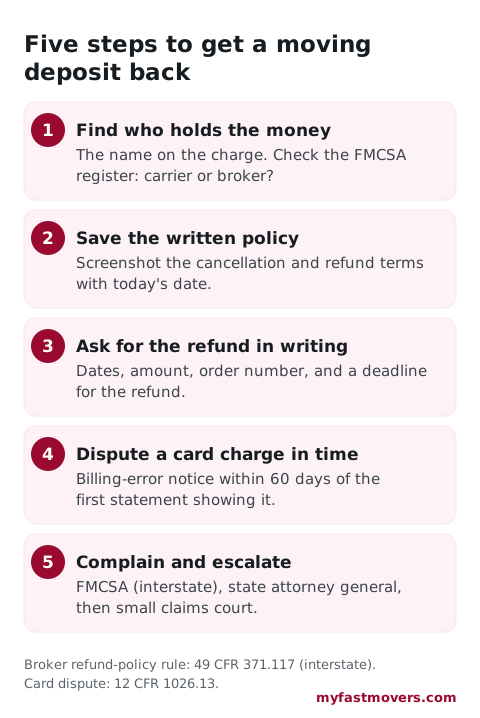
Step 1: Find out who has your money
Look at the receipt or the card statement. The name on the charge is the business that holds the deposit, and it is not always the name on the website.
- Broker or carrier? A household goods broker arranges the move and does not transport. It must say so prominently in its ads and show its physical address and USDOT and MC numbers (371.107). Look the company up in the FMCSA register: how to check a mover’s USDOT number shows where it says carrier or broker.
- If it was a broker, the refund policy it had to publish under 371.117 is the document you hold it to.
- If it was a carrier, its terms are on the estimate, the order for service or the contract you signed. The difference between the two is laid out in moving broker vs carrier.
Step 2: Read the written policy, and save a copy
Find the cancellation and refund terms and screenshot them today, with the date. A broker’s website policy can change, and you want the version that applied when you paid. Note three things:
- The cancellation deadline. Many policies refund in full only if you cancel a set number of days before pickup.
- What is kept, if anything. A flat fee, a percentage, or the whole deposit.
- How the refund is paid and how fast. Card, check, or credit toward a future move.
If the company cancelled, missed the pickup or changed the price before loading and you refused, the policy matters less: you paid for a service that was not delivered as agreed.
Step 3: Ask for the refund in writing
Email the company, and send the same text through any portal or chat it uses. Keep it short and factual:
“I paid a deposit of $[amount] on [date] by [card ending / method] for a move booked for [pickup date], order [number]. [I cancelled on [date], which is [X] days before pickup, within your published refund policy] / [You cancelled the move on [date]] / [No crew arrived on [date]]. Please refund the full deposit to my original payment method within [10] days and confirm in writing.”
Writing does three jobs. It sets the date of your request, which a broker must keep on file for three years. It shows you asked before going to your card issuer. And it is the record an attorney general’s office or a small claims judge will ask to see.
Step 4: Dispute the charge with your card issuer
If you paid by credit card, this is usually the fastest route. The Fair Credit Billing Act and Regulation Z treat a charge for “property or services not accepted by the consumer … or not delivered … as agreed” as a billing error (12 CFR 1026.13(a)(3)).
| What | Rule |
|---|---|
| How to send it | In writing, to the address the issuer gives for billing errors. Many issuers also take disputes online; ask whether that counts as written notice. |
| Deadline | Received no later than 60 days after the issuer sent the first statement that shows the charge (1026.13(b)(1)). |
| What to include | Your name and account number, the charge, the date and amount, and why it is an error. |
| Issuer’s reply | A written acknowledgment within 30 days (1026.13(c)(1)). |
| Issuer’s decision | Within two complete billing cycles, and never later than 90 days (1026.13(c)(2)). |
Worked example, with round dates: you pay a deposit on March 3. The charge first appears on a statement the issuer sends on March 25. The issuer must receive your notice no later than May 24, which is 60 days after March 25. If you wait for the mover to answer emails through June, you lose this route.
Attach the booking confirmation, the refund policy screenshot, your written request and any reply. These rights belong to credit card charges. Cash, a wire or a bank transfer is not an extension of credit, so this route does not cover it, which is one more reason to avoid paying a deposit that way.
Step 5: Complain, then escalate
- FMCSA, for interstate moves. File online at complaint.fmcsa.dot.gov or call 1-888-DOT-SAFT (1-888-368-7238), weekdays 8am to 8pm Eastern. FMCSA says plainly that it “does not have the authority to resolve claims against a moving company”, so do not wait on it for the money. FMCSA’s mover search shows complaint information for each registered company, so your complaint warns the next customer.
- Your state attorney general or consumer protection office. It takes consumer complaints about businesses in the state, including movers on local moves. Use the office in the state where the company is based and where you live.
- Small claims court. For a deposit that is still unpaid after the steps above, small claims is designed for amounts like this. Limits and filing fees are set by each state; check your county court’s website.
Before you pay the next deposit
The cheapest deposit to recover is the one you never paid. Before any money moves:
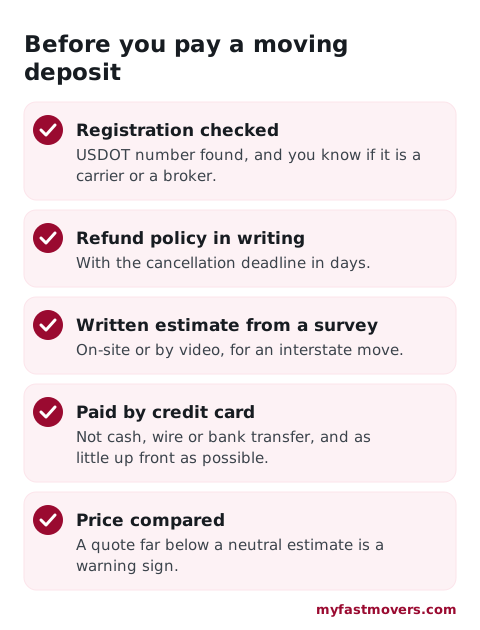
- Check the registration and whether the company is a carrier or a broker.
- Get the refund policy in writing, with the cancellation deadline in days.
- Get a written estimate based on a survey of your home, on-site or by video, as 375.401 requires for interstate moves.
- Pay by credit card, and pay as little up front as the company will accept.
- Compare the price with a neutral figure. A quote far below the moving cost calculator is often the start of a deposit that never comes back. The pattern behind it is in moving scams: red flags.
If the deposit is paid and the move goes ahead, keep the paperwork. Whether the estimate was binding or non-binding decides what you owe at the door.
Questions people ask
Is a moving deposit refundable?
It depends on the written policy you agreed to. No federal rule caps or bans moving deposits. On interstate moves, a household goods broker must disclose its cancellation, deposit and refund policy prominently on its website and in its agreement (49 CFR 371.117). A carrier's terms are in its estimate, order or contract. If the mover cancels or never shows up, the service was not delivered, which is the strongest case for a refund.
How much deposit should a moving company ask for?
There is no legal amount. Interstate carriers are paid at delivery, and federal rules cap what they can collect then at 100 percent of a binding estimate or 110 percent of a non-binding one. FMCSA lists a mover that demands cash or a large deposit before the move as a red flag. A small deposit by credit card, with a written refund policy, is the safest form if one is asked at all.
Can I dispute a moving deposit with my credit card company?
Yes, if the charge was for services not delivered as agreed. Under Regulation Z (12 CFR 1026.13), send the card issuer a written billing-error notice no later than 60 days after it sent the first statement showing the charge. The issuer must acknowledge it within 30 days and resolve it within two billing cycles, and never more than 90 days. Keep your cancellation messages as evidence.
Does FMCSA get my deposit back?
No. FMCSA says it does not have the authority to resolve claims against a moving company. A complaint to FMCSA still matters, because FMCSA's mover search shows complaint information for each company. For the money itself, use the card dispute, your state attorney general or consumer protection office, and small claims court.
Do these rules apply to a local move?
The federal broker rule in 49 CFR Part 371 covers interstate household goods moves. A move that stays inside one state follows that state's rules, which differ. The card dispute right under Regulation Z applies to the card, not the move, so it works for local and long-distance moves alike.
How this was written. Every cost figure in this article comes from the same published model that powers the calculator, so it cannot disagree with the tool. We do not operate trucks and nobody pays us for placement.
Sources
- 49 CFR 371.117, broker cancellation, deposit and refund policies (eCFR) (www.ecfr.gov)
- 49 CFR 371.107, broker advertising and disclosure (eCFR) (www.ecfr.gov)
- 49 CFR 375.401, must I estimate charges? (eCFR) (www.ecfr.gov)
- 49 CFR 375.405, non-binding estimates (eCFR) (www.ecfr.gov)
- 49 CFR 375.703, maximum collect-on-delivery amount (eCFR) (www.ecfr.gov)
- 12 CFR 1026.13, billing error resolution, Regulation Z (eCFR) (www.ecfr.gov)
- 15 U.S.C. 1666, correction of billing errors (Cornell LII) (www.law.cornell.edu)
- FMCSA Protect Your Move, spot the red flags (www.fmcsa.dot.gov)
- FMCSA Protect Your Move, what if I have problems with my move (www.fmcsa.dot.gov)
- FMCSA National Consumer Complaint Database (complaint.fmcsa.dot.gov)