

Moving a Storage Unit to Another State: Options and Rules
How to move the contents of a storage unit across state lines: four ways, what each costs in our model, which federal rules apply, and what to settle first.
Published November 8, 2026 · 8 min read · By My Fast Movers
In short
Sort the unit first, then compare an interstate mover that picks up at the facility, a portable container, a freight trailer you load, and parcel or pallet shipping for a few boxes. Only a mover whose crew loads and unloads is covered by the federal household goods rules, so ask who loads before you book.
To move a storage unit to another state, sort what is inside first, then compare four ways to ship the rest: an interstate mover that picks up at the facility, a portable container, a freight trailer you load yourself, or parcel and pallet shipping for a few boxes. The choice also decides which rules protect you. Only a mover whose own crew loads and unloads is covered by the federal household goods rules, so ask who does the loading before you book.
People who moved away years ago and left a unit behind run into the same questions: the facility is a thousand miles away, nobody remembers exactly what is in it, and every quote seems to assume a full house. This guide walks through the order that keeps the cost down and the paperwork clean.
Start by deciding what is worth moving
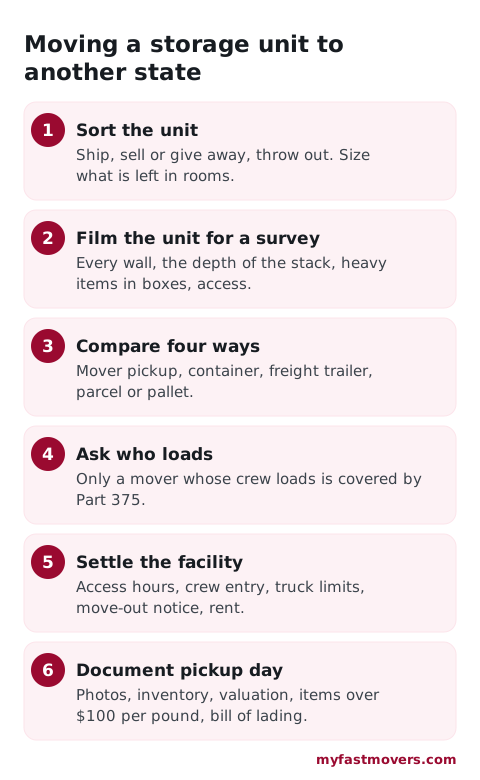
A storage unit is often the least-sorted part of a household. Before you ask anyone for a price, spend a day at the unit, or have someone you trust do it on a video call, and split the contents into three groups: ship, sell or give away, and throw out.
- Ship what you would buy again at the new address, plus anything you cannot replace: photos, papers, heirlooms.
- Sell or donate furniture that is cheaper to replace than to carry across the country. A long-distance price follows weight or volume, so a heavy, low-value piece costs you twice.
- Throw out what has been damaged by damp, pests or age. How to dispose of furniture, appliances and electronics covers the options.
Whatever is left sets the size of the job. Describe it in rooms of a home, because that is how movers and our calculator size a load. If you only know the unit’s dimensions, what size storage unit do I need maps unit sizes to rooms.
Four ways to move it
| Option | Who loads | Best for | Watch out for |
|---|---|---|---|
| Interstate mover, pickup at the facility | The mover’s crew | Heavy furniture, a full unit, or no way to be there for long | Minimum charges and a delivery spread on long hauls |
| Portable container | You, or helpers you hire | A full unit when you can load yourself | Ask whether the facility lets a container be dropped on its property |
| Freight trailer you load | You, or helpers you hire | The cheapest hired option for a part load | Wider delivery windows; all the lifting is yours |
| Parcel or pallet shipping | You | A few boxes, not furniture | Each carrier’s size, weight and liability limits |
Driving it yourself in a rented truck is the fifth route. It only makes sense when you can get to the facility and back, which is often the problem in the first place.
What our cost model says
These are planning figures from our cost model, not quotes, at a 2,500-mile distance. Pick the row closest to what is left in the unit after sorting.
| Load | Full-service movers | Portable container | Freight trailer |
|---|---|---|---|
| Studio | $8,438 – $11,250 | $6,075 – $8,100 | $4,050 – $5,400 |
| One bedroom | $10,125 – $13,500 | $7,290 – $9,720 | $4,860 – $6,480 |
| Two bedrooms | $11,250 – $15,000 | $8,100 – $10,800 | $5,400 – $7,200 |
| Three bedrooms | $12,938 – $17,250 | $9,315 – $12,420 | $6,210 – $8,280 |
How a row is built: distance × a size factor × a rate per service, with the range running from 90% to 120% of that figure. For a one-bedroom load by freight trailer: 2,500 × 1.8 × $1.20 = $5,400, so $4,860 to $6,480. The full-service rate is $2.50 and the container rate $1.80 for the same formula. Run your own distance in the free moving cost calculator.
Two things stand out. Loading the goods yourself is where most of the saving is, since the freight rate is less than half the full-service rate. And a unit packed tight to the ceiling can hold more than it looks from the door, so a mover’s survey can come back higher than the table.
Who you hire decides which rules protect you
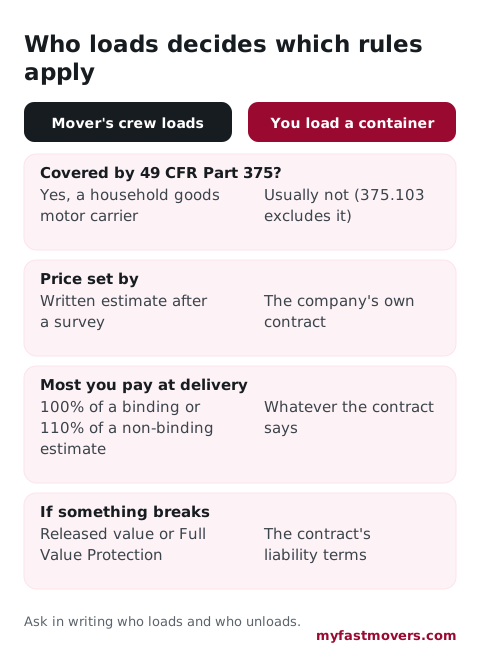
The federal rules for interstate moves, 49 CFR Part 375, apply to a household goods motor carrier moving household goods for an individual shipper in interstate commerce (375.101). Your stored furniture and boxes qualify as household goods: the definition covers “personal effects or property used, or to be used, in a dwelling” when you arrange and pay for the move (375.103).
The catch is in the same definition. It says the term “does not include any motor carrier providing transportation of household goods in containers or trailers that are entirely loaded and unloaded by an individual other than an employee or agent of the motor carrier” (375.103).
In practice:
- A mover whose crew loads at the facility is a household goods motor carrier. You get the survey and written estimate rules, the bill of lading, the 110 percent cap at delivery on a non-binding estimate, released value or Full Value Protection, and arbitration for disputes.
- A container or freight trailer you load and unload yourself usually falls outside that definition. Your price, your delivery window and what the company pays if something breaks come from its own contract, so read the liability and cancellation terms before you pay.
- Mixed jobs need a straight answer. If the company sends its own crew or agents to load or unload, the exclusion no longer fits. Ask in writing who will load, who will unload, and which document sets the liability.
Whoever you choose, look up the company that will actually carry the goods. How to check a mover’s USDOT number shows how, and the FMCSA mover search shows whether a company is registered as a carrier or a broker.
Getting an estimate for goods you cannot walk around
An interstate mover must do a physical survey and give you a written estimate before the move, unless you waive the survey in writing before loading (375.401). The survey can be virtual: the rules count live or pre-recorded video as a physical survey if the mover can clearly identify the goods (375.103). For a storage unit, that makes a careful video the most useful thing you can do.
- Open the unit fully and film each wall, top to bottom, then the floor at the front.
- Pull a few boxes forward so the mover can see how deep the stack goes.
- Name the heavy and fragile items that are boxed or wrapped: a gun safe, a piano, glass tabletops, artwork.
- Describe the access: the unit’s floor, the distance from the unit door to where a truck can park, any elevator, and the facility’s height limit for trucks.
The access details matter for the price. Charges for services such as elevators and long carries must be settled before the bill of lading is prepared (375.401). A storage corridor can be a long carry, so ask for that line on the estimate. If you add goods after a binding estimate, the mover must reaffirm it, write a new one or convert it to non-binding in writing before loading (375.403).
Settle things with the facility before pickup day
The facility is not part of the moving contract, but it can stop the job. Your rental agreement and the facility’s rules decide these points, so ask the office in writing:
- Access hours and gate codes. Will the crew be let in without you, and can you authorize them in writing if you cannot attend?
- Truck limits. Can a large moving truck enter, turn and park near your unit, or does the mover need a smaller truck?
- Move-out notice. How much notice does the facility want before you vacate, and when is your last billing date?
- Rent and the lock. Keep the rent paid until the unit is empty and you have given notice. Unpaid rent is governed by the agreement and state law, and you do not want a dispute over access on loading day.
On pickup day: the paperwork that protects you
- Be there or send someone. A person who knows the goods should watch the inventory being written and check the condition codes against what they see.
- Photograph everything before it leaves the unit, especially furniture that has been sitting for years and may already be marked.
- Choose valuation before loading. Released value is free and pays no more than 60 cents per pound per article. Worked example: a 30-pound box lost in transit would be covered for 30 × $0.60 = $18, whatever is inside. Full Value Protection makes the mover repair, replace or pay up to the declared value, and the federal booklet sets its minimum at $6.00 per pound times the shipment weight (Appendix A).
- List anything worth more than $100 per pound in writing. If you do not, the mover may limit its liability for that article to $100 per pound (375.203).
- Read the bill of lading before you sign: the mover’s name and USDOT number, the pickup and delivery dates, the valuation and the maximum amount due at delivery are all required items (375.505).
If you are only moving a handful of the pieces in the unit, moving a few items long distance compares the small-load options and their minimum charges in more detail.
If both ends are in the same state
Everything above about Part 375 applies to interstate moves. When the storage facility and your new home are in the same state, the move follows that state’s rules, which come from its transportation, public utility or consumer protection agency and differ from state to state. The practical steps still hold: sort the unit, get the estimate in writing with access charges included, settle access with the facility, and document the goods before they leave.
Questions people ask
Can movers pick up directly from a storage unit and take it to another state?
Yes. Interstate movers pick up from storage facilities as an ordinary origin address. Furniture and boxes from your home count as household goods under the federal definition, so the same rules apply as for a house move: a survey, a written estimate, a bill of lading and a choice of valuation (49 CFR Part 375). Check the facility's access hours and truck limits first.
How can a mover give me an estimate if my things are in storage?
By a physical survey of the unit, either on-site or by video. The federal definition counts a virtual survey through live or pre-recorded video as a physical survey, as long as the mover can clearly identify the goods (49 CFR 375.103). Open the unit, film every wall and the floor, and list anything heavy or valuable that sits inside boxes.
Do the federal moving rules apply if I use a container or a freight trailer?
Often not. The federal definition of a household goods motor carrier excludes a company that moves goods in containers or trailers that are entirely loaded and unloaded by someone other than its own employees or agents (49 CFR 375.103). Then the company's contract sets your price, delivery window and liability, so read it before you book.
What does it cost to move a storage unit across the country?
In our cost model, a one-bedroom load over 2,500 miles comes to about $10,125 to $13,500 with full-service movers, $7,290 to $9,720 with a portable container and $4,860 to $6,480 with a freight trailer you load. These are planning figures, not quotes; a mover's survey of the unit sets the real price.
Do these rules apply if the storage unit and the new home are in the same state?
No. 49 CFR Part 375 covers household goods moved in interstate commerce. A move that starts and ends in one state follows that state's rules, set by its transportation, public utility or consumer protection agency, and the rules differ from state to state.
How this was written. Every cost figure in this article comes from the same published model that powers the calculator, so it cannot disagree with the tool. We do not operate trucks and nobody pays us for placement.
Sources
- 49 CFR 375.101, who must follow Part 375 (eCFR) (www.ecfr.gov)
- 49 CFR 375.103, definitions incl. household goods motor carrier and physical survey (eCFR) (www.ecfr.gov)
- 49 CFR 375.203, released value and articles over $100 per pound (eCFR) (www.ecfr.gov)
- 49 CFR 375.401, surveys, written estimates and accessorial charges (eCFR) (www.ecfr.gov)
- 49 CFR 375.403, binding estimates and added goods (eCFR) (www.ecfr.gov)
- 49 CFR 375.211, arbitration (eCFR) (www.ecfr.gov)
- 49 CFR 375.505, contents of the bill of lading (eCFR) (www.ecfr.gov)
- 49 CFR 375.703, maximum collect-on-delivery amount (eCFR) (www.ecfr.gov)
- Appendix A to Part 375, Your Rights and Responsibilities When You Move (eCFR) (www.ecfr.gov)
- FMCSA, Search for a Registered Mover (www.fmcsa.dot.gov)