

How to Pack for Movers: What to Box and What to Leave
Packing for a full-service mover: what goes in boxes, what the crew wraps, how to keep a damage claim on self-packed boxes, and what to keep with you.
Published November 9, 2026 · 8 min read · By My Fast Movers
In short
Box everything small enough to fit in a carton: dishes, books, clothes, decor, pantry and loose drawer contents. Leave furniture, mattresses and large appliances for the crew to wrap, and ask first about TVs, mirrors and art. Pack boxes full and sealed, because poor packing in boxes you pack yourself can reduce the mover's liability.
When you pack for a full-service mover, box everything small enough to fit in a carton and leave the furniture, mattresses and large appliances for the crew. Dishes, books, clothes, decor, pantry items and the contents of drawers and closets go into sealed, labeled boxes. Sofas, bed frames, dressers and the fridge get padded and loaded by the movers. Ask first about TVs, mirrors and framed art. And pack properly, because on an interstate move, poor packing of boxes you pack yourself can reduce what the mover owes you if something breaks.
Self-packing is the most common way to cut a moving bill, and it is where many people get stuck: the mover says “have everything packed,” but some things clearly do not go in a box from the hardware store. This guide draws the line, shows how to pack so a damage claim still works, and lists what never goes on the truck.
The liability, inventory and estimate rules quoted here are the federal rules for interstate household moves (49 CFR Part 375). A move that stays inside one state follows that state’s rules, but the packing advice applies either way.
What “everything packed” actually means
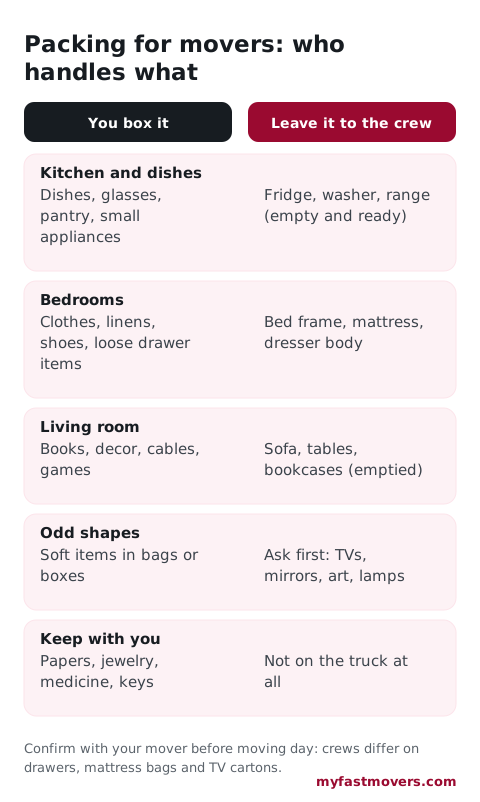
When a mover tells a self-packing customer to have everything packed, it means everything that is not furniture or a large appliance is in a closed box when the crew arrives. In practice:
| Room | You pack | The crew handles |
|---|---|---|
| Kitchen | Dishes, glasses, pots, pantry, small appliances, utensils | Fridge, washer, dryer, range |
| Bedrooms | Clothes, shoes, linens, toys, loose drawer contents | Bed frames, mattresses, dressers, nightstands |
| Living room | Books, media, games, decor, cables, plants you are taking | Sofas, chairs, tables, bookcases, entertainment units |
| Bathrooms | Towels, toiletries you are allowed to ship | Nothing large, as a rule |
| Garage | Hand tools, sports gear, holiday decor | Workbenches, bikes, lawn equipment (drained) |
Furniture does not go in a box. On a full-service move the crew pads and wraps it as part of loading, which is what you are paying the labor rate for. What you do need to do with furniture is empty it: bookcases, cabinets and entertainment units travel empty, and their contents go in boxes.
The gray zone: ask before moving day
A few things fall between “you box it” and “the crew wraps it,” and movers handle them differently. Ask on the estimate visit or call, and get the answer in the written estimate where it changes the price:
- Mattresses. Some movers include mattress bags or cartons; others sell them. If yours does not, buy a bag so the mattress does not ride bare.
- TVs, mirrors, glass tabletops and framed art. These need cartons or crates. Some crews bring them as a priced extra; some expect you to supply them. Our guide to packing fragile items shows how to box each one if the job is yours.
- Beds and tables that come apart. Taking down a bed frame or table legs is often included, sometimes billed. Put the hardware in a labeled bag and tape it to the frame.
- Dresser drawers. Some crews let light clothing stay in the drawers; others want every drawer empty. Nothing heavy, breakable, liquid or valuable should be left in a drawer either way.
- Soft, odd-shaped pieces such as foam play couches, floor cushions and bean bags. These do not need a carton; a large bag or plastic wrap keeps them clean and is enough for most crews.
Pack so your damage claim still works
This is the part people skip, and it is the reason to pack well rather than just fast.
An interstate mover is legally liable for loss and damage during the move (49 CFR 375.201). But the federal booklet for interstate moves, Your Rights and Responsibilities When You Move, lists actions that “may limit or reduce your mover’s liability.” The first one on the list is your own acts or omissions, and its example is improper packing of containers you pack yourself that do not give sufficient protection.
So the question after a breakage becomes: did the box fail because of how it was handled, or because of how it was packed? A carton crushed from the outside points at handling. A plate that broke because it was loose in a half-empty box with no paper points at packing. To keep the claim on the right side of that line:
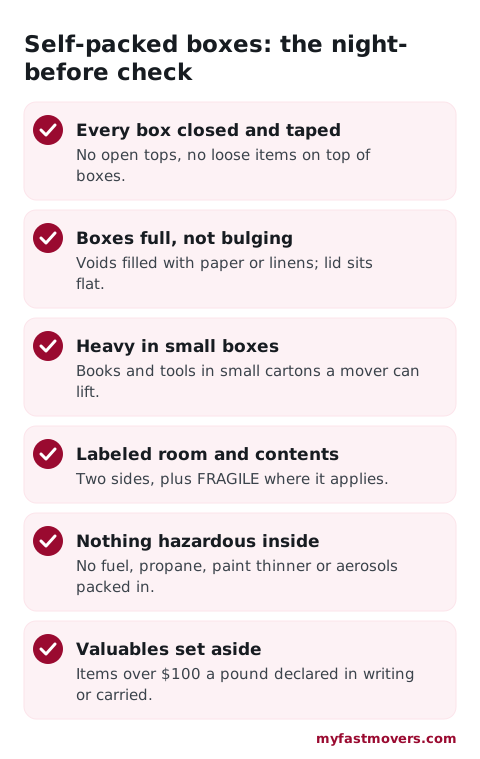
- Use real moving cartons, not grocery boxes, for anything heavy or breakable.
- Fill every box. A half-empty box collapses when another box is stacked on it. Fill gaps with packing paper, towels or linens until the lid sits flat.
- Keep heavy items in small boxes. Books, tools and canned food go in small cartons that one person can lift. A large box of books is the one that splits.
- Wrap breakables one by one and stand plates on edge. The fragile-items guide covers dish packs, glasses and electronics.
- Tape the bottom and the top, along the center seam and across the edges.
- Label two sides with the room and a short contents note, and write FRAGILE where it applies.
- Photograph the inside of fragile boxes before you seal them. A photo of a well-packed box is the evidence you will want if the contents arrive broken.
How much a broken self-packed box pays
What you get for a broken item also depends on the valuation level on your bill of lading. Full value protection is the default liability on an interstate move (375.201). If you waived it in writing and chose released value, the mover’s liability is 60 cents per pound per article.
Worked example (round numbers): a 30 lb box of dishes, all broken, under released value pays 30 × $0.60 = $18. That is why packing well matters most when you are on released value, and why the valuation choice deserves a look before you sign. Moving insurance vs valuation explains both levels.
Check the inventory when the crew loads
An interstate mover must write an itemized inventory that identifies every carton and every uncartoned item, and put a matching number on each one (375.503). It is prepared at or before loading, you have the right to watch and check it, and you get a signed copy with the bill of lading.
For a self-packer this is the moment that counts:
- Count your boxes before the crew arrives and compare the total with the inventory. A box missing from the inventory is a box you cannot easily prove was shipped.
- Read the condition notes. The crew records the condition of what it loads, and it may note that you packed a carton yourself. If a note is wrong, the federal booklet says you have the right to note your disagreement before you sign.
- At delivery, check off every number. The mover must let you note missing articles and damage in writing at delivery (375.503(d)), and the booklet says your ability to recover can depend on those notes. How to file a moving damage claim walks through the rest.
What never goes in your boxes
Some things should not be packed at all, and some should not go on the truck:
- Hazardous materials. Federal law forbids shipping hazardous materials in household goods boxes without telling the mover, and a mover is not liable for undisclosed perishable, dangerous or hazardous articles or the damage they cause (375.203(a)). That covers fuel, propane, many aerosols, paint thinner, pool chemicals and similar. What movers won’t move has the full list, including batteries and plants.
- Perishable food. Same rule: undisclosed perishables are your risk.
- High-value items. On an interstate move, if you do not tell the mover in writing about an article worth more than $100 per pound, its liability for that article can be capped at $100 per pound (375.203(b)). Jewelry, coins, watches and small collectibles easily pass that line. Declare them in writing or carry them.
- What you need the first night and the first week. Documents, passports, medicine, chargers, keys, laptops and hard drives, a change of clothes and basic toiletries. A long-distance shipment can take days or weeks to arrive.
Finish before the crew arrives
On a local move you pay for the crew’s time. Our model prices professional crews at $40–$50 per mover per hour, and a three-bedroom home at a crew of three. So every hour a three-person crew spends waiting while you tape the last boxes costs 3 × $40 to 3 × $50, or $120 to $150. For a two-person crew it is $80 to $100 an hour.
The fixes are simple:
- Pack a room a day for the last week and a half, starting with the rooms you use least.
- Stage boxes by the door in each room, with a clear path to the exit.
- Keep a “do not load” area, such as an empty bathroom or the car, for what travels with you, and tell the crew lead about it first thing.
- Get the box count right. Our moving box calculator estimates how many cartons of each size a home your size needs, so you are not taping the last box at 7 a.m.
On an interstate move the time pressure works differently, but packing still affects the bill. On a non-binding estimate, the final charges are based on the actual weight of your shipment (375.401). Every box of books you keep adds to that weight, which is why clearing out before you pack pays off twice. For the rest of the price, run your route and home size through the free moving cost calculator, and compare it with your quote.
Packing yourself vs paying the mover to pack
Self-packing makes sense when you have time, a few weeks of evenings, and mostly ordinary belongings. Paying for packing is worth considering for a large kitchen, a lot of glass and art, or a tight deadline, and a partial pack (the mover packs only the kitchen and fragile items) is a common middle path. Packing services cost shows how a packing bill is built and when it pays for itself.
Whichever way you go, the rules above do not change: sealed full boxes, a checked inventory, nothing hazardous in the cartons, and the valuables with you.
Questions people ask
What do I need to pack before the movers come?
Everything that fits in a box: kitchenware, books, clothes, linens, decor, toys, tools, pantry items and the small things in drawers and closets. The crew wraps and loads furniture, mattresses and large appliances. Have every box closed, taped and labeled before the crew arrives, and set aside what travels with you.
Do movers wrap furniture or do I have to?
On a full-service move the crew normally pads and wraps furniture as part of loading, so you do not need to wrap a sofa or a dresser yourself. What varies by company is mattress bags, TV cartons and taking beds apart. Ask your mover which of those are included and which are extra before moving day.
Are movers liable for boxes I packed myself?
Movers are liable for loss and damage during the move, but the federal booklet for interstate moves says improper packing of containers you pack yourself can limit or reduce that liability. A carton that is crushed from the outside is a different case from a plate that broke because it was loose in the box.
Can I leave clothes in dresser drawers for movers?
It depends on the mover. Some crews let light, soft clothing stay in drawers; others want every drawer empty because of the weight and the risk of drawers sliding open. Ask on the estimate visit, and never leave anything heavy, breakable, liquid or valuable in a drawer.
What should I not pack in boxes for movers?
Hazardous materials such as fuel, propane, paint thinner and many aerosols, perishable food, and anything you could not stand to lose: documents, jewelry, cash, medicine, keys and hard drives. On an interstate move you must tell the mover in writing about any item worth more than $100 per pound, or its liability for that item can be capped.
How this was written. Every cost figure in this article comes from the same published model that powers the calculator, so it cannot disagree with the tool. We do not operate trucks and nobody pays us for placement.
Sources
- Appendix A to Part 375, Your Rights and Responsibilities When You Move (eCFR) (www.ecfr.gov)
- 49 CFR 375.201, normal liability for loss and damage (eCFR) (www.ecfr.gov)
- 49 CFR 375.203, shipper actions that limit liability (eCFR) (www.ecfr.gov)
- 49 CFR 375.401, binding and non-binding estimates (eCFR) (www.ecfr.gov)
- 49 CFR 375.503, the written inventory (eCFR) (www.ecfr.gov)