

Hiring Movers Just to Load a Truck or Container
How labor-only loading help works: what the crew does, what it costs in our model, who pays if something breaks, and what to put in writing before moving day.
Published November 11, 2026 · 8 min read · By My Fast Movers
In short
Yes. A labor-only crew loads the rental truck or container you arranged. In our model that is $25–$35 per mover per hour plus a $75 travel fee, or $325–$565 to load a two-bedroom home. The crew does not drive, so federal mover protections do not cover its work: settle damage terms in writing before moving day.
Yes, you can hire movers just to load a truck or container you rented yourself, and for many moves it is the best split of money and effort. A labor-only crew carries, pads and stacks; you (or the container company) do the driving. In our published model a labor-only crew costs $25 to $35 per mover per hour plus a $75 travel fee, which is $325 to $565 to load a two-bedroom home. The trade-off is protection: a crew that only loads is not a moving carrier, so the federal valuation and claim rules for interstate moves do not cover its work. Settle what happens if something breaks, in writing, before moving day.
This question comes up every week from people who have priced a rental truck or a portable container and still cannot carry a sofa down three flights of stairs by themselves. This guide covers what a loading crew does and does not do, what it costs in our model, who is responsible for damage, and what to confirm when you book.
The federal rules quoted here apply to interstate household moves (49 CFR Part 375 and 49 U.S.C.). A move that stays inside one state follows that state’s rules, and many states do not license labor-only crews at all. Our guide to who regulates moving companies lists the main state agencies.
What a loading crew does, and what stays your job
“Labor-only” means the crew supplies people and usually basic equipment, and you supply the vehicle. The split looks like this:
| Task | Labor-only crew | You |
|---|---|---|
| Rent the truck, trailer or container | ✔ | |
| Pack boxes | Only if booked and paid as extra hours | ✔ usually |
| Take apart beds and tables | Often, ask first | ✔ if not included |
| Pad and wrap furniture | ✔ if they bring pads, ask | Buy or rent pads if not |
| Carry everything out and load it | ✔ | |
| Strap the load and close the door | ✔ | Check it before they leave |
| Drive the truck or arrange container pickup | ✔ | |
| Unload at the other end | Only if you book a crew there too | ✔ or a second crew |
Two lines in that table cause most of the trouble on moving day. Packing: if the crew arrives to find half the kitchen unboxed, you pay their hourly rate to watch you pack, or they pack for you at that rate. Pads and straps: some crews bring blankets, dollies and straps, some expect you to rent them with the truck. Ask, and get the answer in the booking.
What it costs in our model
Labor-only work is billed by the hour. Our local model uses the same formula as for full-service local moves: crew size × hours on site × rate, plus a travel fee. For labor-only crews the rate is $25 to $35 per mover per hour and the travel fee is $75. The crew sizes and hours below are the model’s standard local jobs, used here for one end of the move.
| Home | Crew | Hours on site | One end (load only) | Both ends (load and unload) |
|---|---|---|---|---|
| Studio | 2 | 2–3 | $175 – $285 | $350 – $570 |
| 1 small bedroom | 2 | 3–5 | $225 – $425 | $450 – $850 |
| 2 bedrooms | 2 | 5–7 | $325 – $565 | $650 – $1,130 |
| 3 bedrooms | 3 | 6–9 | $525 – $1,020 | $1,050 – $2,040 |
| 4 bedrooms | 4 | 8–10 | $875 – $1,475 | $1,750 – $2,950 |
Each “one end” figure is the arithmetic of the model. For two bedrooms: 2 movers × 5 hours × $25 + $75 = $325, and 2 movers × 7 hours × $35 + $75 = $565. “Both ends” is twice that. Our model scales the hourly rate by each state’s hand-mover wage, so a quote in a high-wage state can sit above this band. The full rate table is in local movers cost per hour, and the free moving cost calculator prices the rest of the move.
Worked example (round numbers, hypothetical). A two-bedroom apartment, a rental truck you drive 1,000 miles, a crew to load and another to unload. At the model’s low end the labor is $650 for both ends; at the high end, $1,130. Add the truck, fuel and nights on the road from your own quotes, and compare the total with full-service quotes for the same home.
What pushes the hours up
The hours are what you control. Crews get through a load faster when:
- every box is packed, taped and stacked near the door, not spread through every room;
- beds and tables are already apart, with hardware bagged and taped to the frame;
- the truck or container is parked as close as legally possible, with any permit or building elevator booked;
- the heaviest pieces are cleared of contents (dressers, bookcases, filing cabinets).
Ask whether the crew bills a minimum number of hours, how it rounds partial hours, and whether drive time to your door is inside the travel fee or billed by the hour. Those three answers change the bill more than the hourly rate does.
Who pays if something breaks
This is the part most people miss, and it is where a labor-only move differs from hiring a full-service mover.
The federal household goods rules attach to carriers that transport. Part 375 applies to a household goods motor carrier “only when you transport household goods for individual shippers by motor vehicle in interstate commerce” (49 CFR 375.101). The liability rule in 49 U.S.C. 14706 is likewise about the carrier that receives the goods for transportation. A crew that loads your rental truck and leaves is not transporting your goods; you are. So the protections that come with an interstate mover (a required valuation option, a written claims process, an arbitration program) are not built into a labor-only booking.
Containers have their own exclusion. The federal definition of a household goods motor carrier “does not include any motor carrier providing transportation of household goods in containers or trailers that are entirely loaded and unloaded by an individual other than an employee or agent of the motor carrier” (49 CFR 375.103; the same limited service exclusion is in 49 U.S.C. 13102(12)). When you, or a crew you hired separately, load a portable container, the container company’s contract sets its delivery and liability terms, not Part 375. If the container company sends its own employees or agents to load, the exclusion no longer fits that wording, so ask the company how it classifies that service.
That leaves three places to look when something breaks:
- The crew’s written terms. Before booking, ask how a damage claim works, the deadline to report it, and whether the crew carries liability insurance that would pay. Get the answer in the confirmation email or contract, not on the phone.
- The rental agreement. Damage to the truck itself (a dented door frame, a torn liner) falls under your rental contract and whatever protection you bought with it. The crew is not a party to that contract, so read who pays before the crew touches the truck.
- Your own documentation. Photograph valuable pieces before loading and the inside of the truck or container before the first item goes in. If a crew drops a dresser, you want a before picture.
If you book through a booking site or marketplace, read its terms as well: the site, the crew and you may each have a different role in a damage claim.
How to book a crew: what to settle in writing
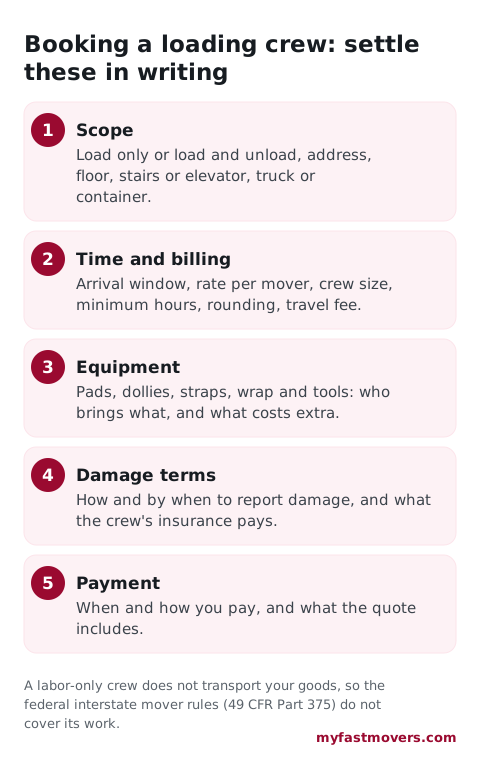
The five points in the figure above are the minimum. In order:
- Scope. Load only, or load and unload? Which address, which floor, stairs or elevator, which vehicle (truck length or container brand)?
- Time and billing. Arrival window, hourly rate per mover, crew size, minimum hours, how partial hours round, and the travel fee.
- Equipment. Pads, dollies, straps, shrink wrap and tools for disassembly: who brings what, and which items are extra.
- Damage terms. How to report damage, by when, and what the crew’s insurance covers. Ask for proof of insurance if it matters to you.
- Payment. When you pay (after the job is the norm to ask for), how, and whether the quote includes tips or card fees. For tipping customs, see do you tip movers.
If the same company offers to drive your goods to another state, it is no longer labor-only. It is acting as an interstate mover and needs federal registration. Check its USDOT number before you agree.
On loading day
Have the truck or container in place before the crew’s arrival window opens; a crew waiting on a late rental pickup is billing you. Walk the crew through the home once: what goes, what stays, what is fragile, and what travels in your car.
A good crew loads heavy pieces first, low and against the front wall, and builds tiers to the ceiling with a strap across each one. Our guide on how to load a moving container explains that order, and it applies to a rental truck box too. If you are hiring a crew, it is still worth knowing what a tight load looks like, because you are the one who will drive it.
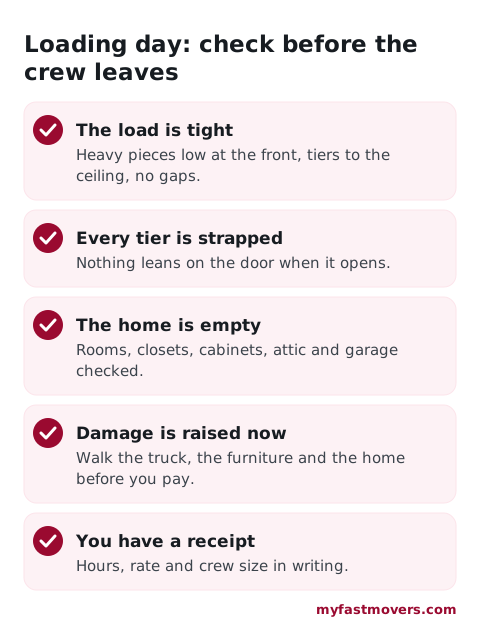
Before the crew leaves:
- look inside: no gaps a box can fall into, straps across every tier, nothing leaning on the door;
- check the rooms and closets so nothing is left behind;
- walk the truck or container and the home for any damage, and raise it before you pay;
- keep the receipt showing hours, rate and crew size.
When a labor-only crew is the wrong choice
Labor-only works when the main problem is weight and stairs. It is weaker when:
- the goods are valuable or fragile, and you want a mover’s valuation and claim process behind them;
- nobody in the household can drive a large truck a long way, and a container does not fit your timing;
- the home is large. In our model the labor for a four-bedroom home, at both ends, is $1,750 to $2,950 on top of the truck or container. Our comparison of moving containers vs full-service movers shows where that hybrid stops saving money.
For a small apartment, a short timeline and a renter who is happy to drive, hiring movers only to load the truck is often the cheapest way to avoid carrying everything yourself, as long as the damage terms are written down before the first box moves.
Questions people ask
Can I hire movers just to load a truck?
Yes. Labor-only crews load a rental truck, trailer or portable container that you rented, then leave; you or the container company handle the driving. You can book the same kind of crew at the other end to unload. Expect to have everything boxed before they arrive, because the hours you pay for should go to carrying, not packing.
How much does it cost to hire movers to load a truck?
In our published local model, labor-only crews are $25 to $35 per mover per hour plus a $75 travel fee. A two-bedroom home is two movers for five to seven hours, which works out to $325 to $565 at one end. Rates in our model scale with each state's mover wage, so local quotes can sit above or below that band.
Who is responsible if a labor-only crew breaks something?
Whatever the crew agreed to in writing, plus its own insurance. The federal liability and claim rules for interstate moves apply to carriers that transport household goods, and a crew that only loads a vehicle you drive is not transporting anything. Ask before booking how damage claims work, what the crew's coverage pays, and get it in the booking confirmation.
Do labor-only movers need a USDOT number?
Not for loading alone. Federal registration is for carriers that transport household goods across state lines. A crew that loads your rental truck and drives away empty is not a carrier for your shipment. If the same company offers to drive your goods to another state, it is acting as a mover and you should check its USDOT number.
Should I hire loading help for a PODS or U-Box container?
It often makes sense, because the container company only moves the box. Hiring an outside crew keeps the move a self-loaded container shipment, which the federal definition excludes from the household goods mover rules. That means the container company's contract, not Part 375, sets your delivery and liability terms, and the crew's own terms cover the loading.
How this was written. Every cost figure in this article comes from the same published model that powers the calculator, so it cannot disagree with the tool. We do not operate trucks and nobody pays us for placement.
Sources
- 49 CFR 375.101, who must follow the household goods rules (eCFR) (www.ecfr.gov)
- 49 CFR 375.103, definitions incl. household goods motor carrier (eCFR) (www.ecfr.gov)
- 49 U.S.C. 13102, definitions incl. household goods motor carrier and its limited service exclusion (Cornell LII) (www.law.cornell.edu)
- 49 U.S.C. 14706, liability of carriers under receipts and bills of lading (Cornell LII) (www.law.cornell.edu)